


Object-oriented design relies heavily on the ability to model relationships between different entities within a system. When constructing a robust architecture, understanding how classes interact is paramount. Among the various relationship types depicted in Unified Modeling Language (UML) Class Diagrams, aggregation and composition stand out as critical structural connectors. These relationships define not just how objects are linked, but how they exist, persist, and manage their lifecycles relative to one another. 🛠️
This guide provides a deep dive into the nuances of aggregation and composition. We will explore their visual representations, semantic meanings, and the practical implications of choosing one over the other in system design. By the end of this article, you will have a clear mental model for distinguishing these concepts and applying them correctly to your software structures. 💡
Foundations: The Context of Association 📐
Before dissecting aggregation and composition, it is necessary to establish the baseline: Association. An association represents a structural relationship between two classes where objects of one class are connected to objects of another. It is the most general form of relationship. Think of it as a line connecting two boxes in a diagram. 📏
- Association: A generic link between two classes. It implies that objects in one class are aware of objects in another.
- Multiplicity: Associations often include cardinality, such as 1-to-many or many-to-many, defining how many instances of one class relate to another.
- Navigation: Associations can be navigable (one class knows the other) or bidirectional (both classes know each other).
Aggregation and composition are specialized forms of association. They add a layer of meaning regarding ownership and lifecycle dependency. While a standard association might simply mean “Class A knows Class B,” aggregation and composition answer the question: “Does Class A own Class B?” and “Does Class B survive without Class A?” 🤔
Aggregation: The ‘Has-A’ Relationship 🤝
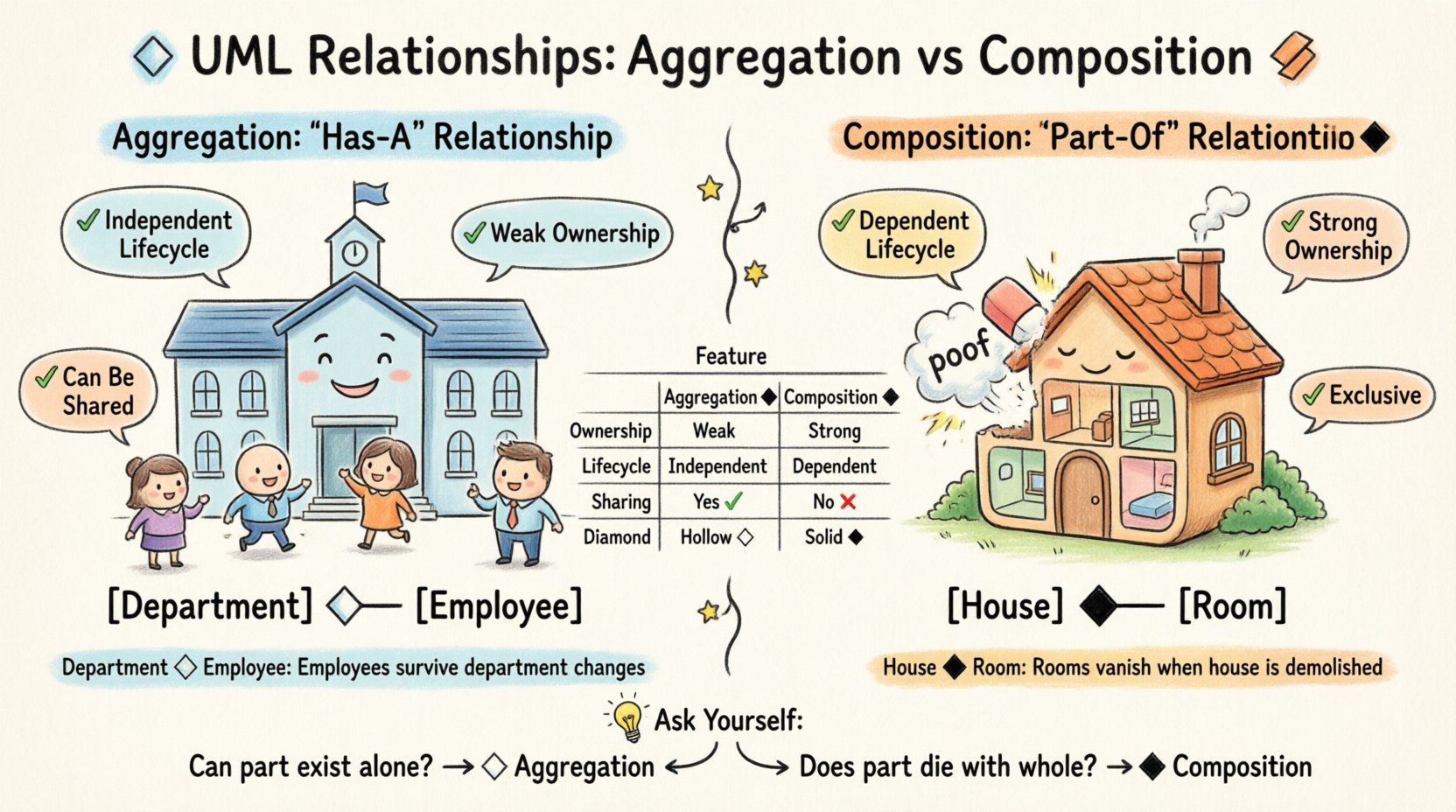
Aggregation is a specific type of association that represents a whole-part relationship where the part can exist independently of the whole. It is often described as a ‘Has-A’ relationship. In this scenario, the whole object has a reference to the part object, but the lifecycle of the part is not controlled by the whole. 🧩
Visual Notation
In UML Class Diagrams, aggregation is depicted by a line connecting the two classes with a hollow diamond shape at the end of the line pointing towards the ‘whole’ class. The diamond represents the container, and the line represents the link. 🖍️
Key Characteristics
- Independence: The part object can exist without the whole object. If the whole is destroyed, the part is not necessarily destroyed.
- Weak Ownership: The whole does not have exclusive control over the creation or destruction of the part.
- Shared Usage: The same part object can often be shared among multiple whole objects simultaneously.
Real-World Example: Department and Employee 👨💼
Consider a university system. A Department class and an Employee class exist. A department consists of employees. However, if the department is dissolved or restructured, the employees do not cease to exist. They may move to another department or leave the university entirely. The employees have a lifecycle independent of the specific department instance. 🏫
- Scenario: Employee A is assigned to Department X.
- Event: Department X is merged into Department Y.
- Outcome: Employee A still exists and is now assigned to Department Y. The death of Department X does not kill Employee A.
This independence is the defining feature of aggregation. It allows for flexibility in system design, enabling objects to be shared and reused without the overhead of constant recreation. 🔄
Composition: The ‘Part-Of’ Relationship 🏗️
Composition is a stronger form of aggregation. It also represents a whole-part relationship, but with a strict lifecycle dependency. If the whole object is destroyed, the part objects are destroyed with it. This is often described as a ‘Part-Of’ relationship. It implies strong ownership. 🛡️
Visual Notation
In UML Class Diagrams, composition is depicted similarly to aggregation, but with a filled (solid) diamond at the end of the line pointing towards the ‘whole’ class. The solid diamond signifies exclusive ownership and lifecycle control. 💎
Key Characteristics
- Dependence: The part object cannot exist independently of the whole object. It is created and destroyed with the whole.
- Exclusive Ownership: The whole has exclusive control over the part. A part typically belongs to only one whole at a time.
- Implicit Creation: The creation of the whole often necessitates the creation of the parts.
Real-World Example: House and Room 🏠
Imagine a House class and a Room class. A house is composed of rooms. If the house is demolished, the rooms cease to exist as rooms. They might be repurposed as materials (bricks, wood), but the structural entity of the ‘Room’ no longer exists. 🧱
- Scenario: House A contains Room 1 and Room 2.
- Event: House A is destroyed (e.g., sold and demolished).
- Outcome: Room 1 and Room 2 are destroyed. They do not persist in the system to be used elsewhere.
This strict dependency ensures data integrity and resource management. When the parent object is cleaned up, the child objects are automatically managed, preventing orphaned data structures. 🧹
Aggregation vs. Composition: A Detailed Comparison 📊
To clarify the distinctions, we can examine a side-by-side comparison of the two concepts. Understanding the differences is crucial for accurate modeling and future-proofing the codebase. 🔍
| Feature | Aggregation | Composition |
|---|---|---|
| Relationship Type | Has-A | Part-Of |
| Ownership | Weak Ownership | Strong Ownership |
| Lifecycle | Independent | Dependent |
| UML Notation | Hollow Diamond (◇) | Solid Diamond (◆) |
| Shared Instances | Yes (Can be shared) | No (Exclusive) |
| Example | Library and Books | Car and Engine |
Note on Examples: In the ‘Library and Books’ example, a library can close, but the books may be transferred to another library or sold. In ‘Car and Engine’, if the car is scrapped, the engine is typically removed and considered part of the scrap process, losing its identity as a functional car engine component. 🚗
Visualizing the Diagrams 🎨
When drawing these diagrams, clarity is essential. Misusing the diamond notation can lead to confusion for other developers reading the architecture. Here is how the structure typically appears in a textual representation of a class diagram.
Aggregation Structure
Imagine a Car class and an Owner class. An aggregation relationship exists here. The car is owned by the owner. However, if the car is totaled, the owner still exists. Conversely, if the owner sells the car, the car still exists. This is often a bidirectional aggregation.
Car◇───────○Owner
Composition Structure
Consider a Order class and a LineItem class. An order is composed of line items. If the order is cancelled and deleted from the system, the line items associated with it are also deleted. They have no meaning outside the context of that specific order.
Order◆───────○LineItem
Notice the direction of the diamond. The diamond always points to the ‘Whole’ or the container. The line connects to the ‘Part’. This directionality is non-negotiable in standard UML notation. 📐
Implications for Code and Memory Management 💾
While UML diagrams are abstract, the choices made during design directly influence implementation details, particularly regarding memory management and garbage collection. 🧠
Aggregation in Code
When implementing aggregation, you typically use weak references or standard references that do not enforce exclusive ownership. The parent class receives an instance of the child class as a constructor argument or via a setter method. The parent does not take responsibility for disposing of the child.
- Constructor: The child object might be created outside the parent.
- Destruction: The parent does not call a destructor or dispose method on the child.
- Sharing: The same child instance can be passed to multiple parent instances.
Composition in Code
Composition requires the parent to take full responsibility for the lifecycle of the child. This is often achieved through value objects or by ensuring the child is instantiated strictly within the parent’s scope.
- Constructor: The child object is created inside the parent’s constructor.
- Destruction: When the parent is garbage collected or explicitly destroyed, the child references are lost, and the child is cleaned up.
- Encapsulation: The child is often hidden (private) within the parent, preventing external access.
This distinction affects how you write unit tests. For aggregation, you might need to mock the child object because it exists independently. For composition, the child is an internal detail, and tests focus on the parent’s behavior regarding the child. 🧪
Common Pitfalls and Misconceptions ⚠️
Even experienced designers can stumble when defining these relationships. Here are common errors to avoid when modeling your system. 🚫
- Confusing Association with Aggregation: Just because two classes are related does not mean one aggregates the other. If there is no ‘whole-part’ semantic, use a plain association line. Do not use a diamond if there is no ownership implication.
- Overusing Composition: Composition is heavy. It implies tight coupling. If the parts need to be reused in different contexts, composition will force you to duplicate them or manage complex lifecycles. Use aggregation for flexibility.
- Ignoring Lifecycle Rules: If you model something as composition, you must ensure the code respects that lifecycle. If a ‘Room’ is deleted when a ‘House’ is deleted, the code must reflect that cleanup. If the ‘Room’ persists, your diagram is wrong.
- Directionality Errors: Always ensure the diamond points to the container. A diamond pointing to the part is invalid UML syntax and causes confusion.
Refactoring: Changing Relationships 🛠️
Design is rarely static. Requirements change, and models evolve. It is possible to refactor from aggregation to composition or vice versa. However, this is not a trivial operation. 🔄
Aggregation to Composition
This change increases coupling. You are deciding that the part can no longer exist without the whole. This requires ensuring that the part is created within the whole and destroyed with it. It often involves moving initialization logic from external code into the parent class. 🧩
Composition to Aggregation
This change increases flexibility. You are allowing the part to exist independently. This requires removing the destruction logic from the parent. The parent must now accept a part that might have been created elsewhere. This can introduce null reference risks if not managed carefully. 🛡️
When making these changes, documentation and communication are key. The diagram is a contract for the developers working on the system. Changing it alters the expectations of how the system behaves. 📢
Database Schema Parallels 🗄️
Although UML is for object design, these concepts often map to relational database structures, though not perfectly. Understanding the mapping helps in backend development. 🗃️
- Aggregation: Often maps to a Foreign Key relationship where the referenced row can exist without the referencing row. For example, an
Employeetable and aDepartmenttable. Deleting a department does not delete the employee row; it might just set the foreign key to NULL. - Composition: Often maps to a Foreign Key relationship with a CASCADE DELETE constraint. If the parent row is deleted, the child rows are automatically deleted. For example,
OrderHeaderandOrderLine. Deleting the header deletes the lines.
Recognizing this pattern helps in designing schemas that align with the object model. It prevents orphaned records and ensures data consistency across the application layers. 🔗
Advanced Scenarios: Multiple Inheritance and Interfaces 🕸️
When dealing with complex systems, aggregation and composition interact with other design patterns. It is important to distinguish these relationships from inheritance. 🧬
- Inheritance (Is-A): A subclass inherits properties from a superclass. This is a type relationship, not a containment relationship. A Dog is a Mammal. A Car has a Engine.
- Interface Implementation: An object can implement multiple interfaces. Aggregation and composition deal with instances, whereas interfaces deal with contracts.
A class can have both. A Vehicle class might inherit from a Transport class (Inheritance) and compose a Engine object (Composition). Understanding the boundaries between these relationships prevents circular dependencies and keeps the codebase clean. 🧹
Guidelines for Decision Making 🧭
When faced with a design choice, ask the following questions to determine the correct relationship type. These heuristics will guide you toward the right model. 🧐
- Can the part exist without the whole?
If yes, consider Aggregation. If no, consider Composition. - Does the whole create the part?
If the whole is responsible for the part’s creation, Composition is likely appropriate. If the part is created externally, Aggregation is better. - Can the part be shared?
If the same part instance needs to be used by multiple wholes, Aggregation is required. Composition implies exclusive ownership. - What is the semantic meaning?
Does ‘Part-Of’ feel more accurate than ‘Has-A’? Trust the semantics of your domain model.
These questions form a checklist for your design reviews. They help ensure that the model reflects the reality of the business logic. 📝
The Impact on Maintainability 🔧
Correctly identifying aggregation and composition directly impacts the maintainability of the software. When relationships are clear, refactoring becomes safer. Developers know which objects are safe to delete and which are dependencies. 🛡️
- Clear Boundaries: Composition defines clear boundaries for scope. You know exactly what belongs to an object.
- Reduced Coupling: Aggregation reduces coupling by allowing independent lifecycles. This makes the system more modular.
- Debugging: When a bug occurs, understanding the lifecycle helps trace the origin. Did the part disappear because the whole was deleted (Composition) or was it removed manually (Aggregation)?
Investing time in modeling these relationships correctly pays dividends in the long term. It reduces technical debt and makes the system easier to understand for new team members. 👥
Summary of Visual Elements 🎨
To recap the visual distinctions, keep this quick reference in mind when drawing your diagrams.
- Solid Diamond (◆): Composition. Strong ownership. Dependent lifecycle. Part dies with Whole.
- Hollow Diamond (◇): Aggregation. Weak ownership. Independent lifecycle. Part survives Whole.
- Plain Line (—): Association. General relationship. No ownership implied.
Consistency in your notation is vital. If you mix up the diamond types, the diagram becomes misleading. Treat the notation as a precise language, not just a drawing style. 📐
Final Thoughts on System Design 🌟
Aggregation and composition are more than just diagrammatic symbols; they are expressions of intent. They communicate how your system is structured and how data flows through it. By mastering these distinctions, you create models that are robust, clear, and aligned with the underlying business logic. 🏗️
Remember that diagrams are living documents. As the system evolves, revisit your relationships. Ensure that the composition still holds true and that aggregation hasn’t become overly complex. Continuous validation of these models ensures that your architecture remains sound over time. 🔄
Apply these principles consistently across your projects. The effort spent on precise modeling now will save significant time during future maintenance and scaling. Your diagrams will serve as a reliable map for the journey ahead. 🗺️