


Building a robust e-commerce platform requires more than just coding; it demands a clear architectural blueprint. Without a solid foundation, systems become fragile and difficult to scale. This guide explores the practical application of Unified Modeling Language (UML) class diagrams to design a comprehensive e-commerce system. We will move beyond theory to examine the specific entities, relationships, and constraints that define modern online retail architectures.
UML class diagrams serve as the backbone of object-oriented design. They visualize the static structure of a system by illustrating classes, their attributes, operations, and the relationships among objects. In this context, we analyze how to translate business requirements into a technical schema that developers can implement with precision.
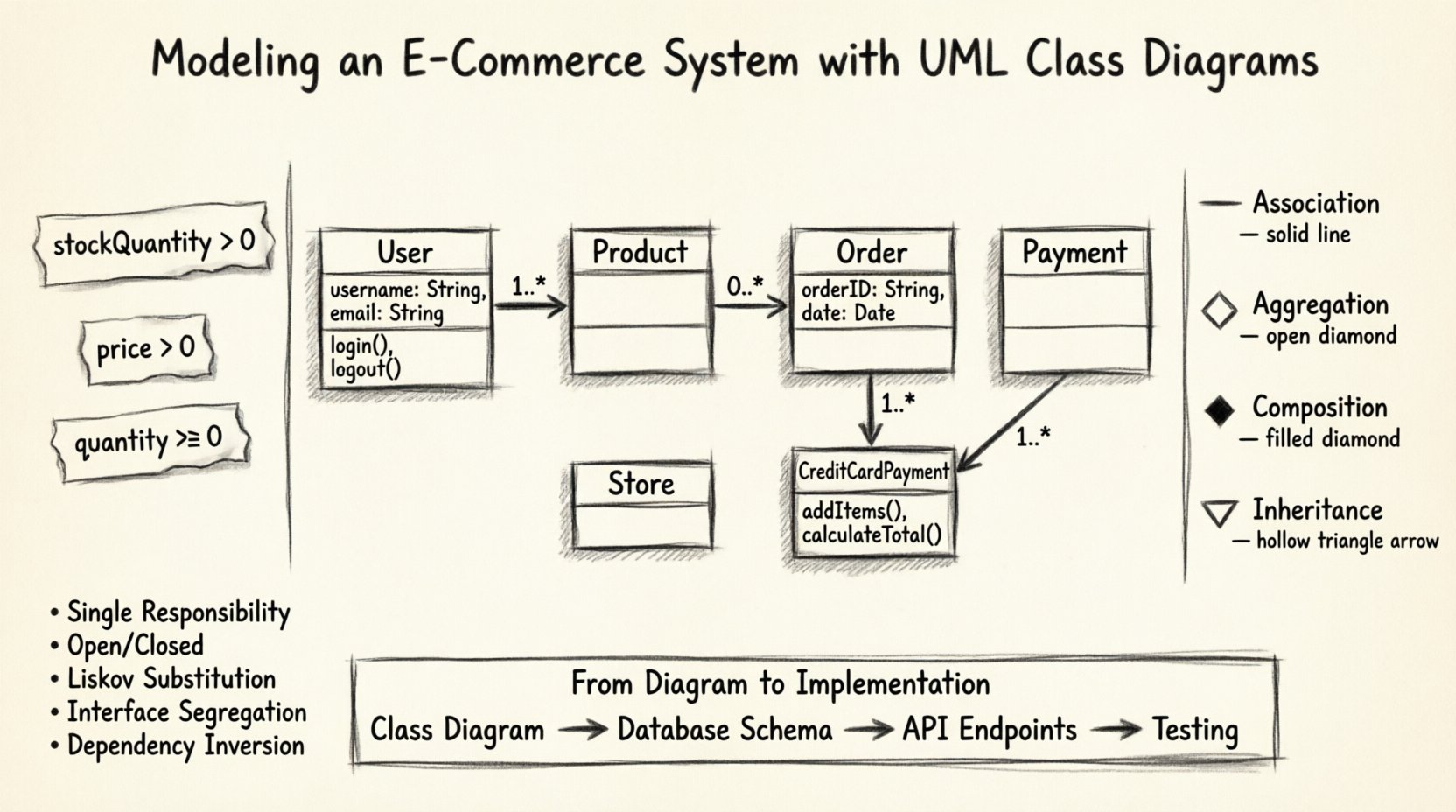
🏗️ Understanding the Domain: E-Commerce Requirements
Before drawing a single box, one must understand the business domain. An e-commerce system is complex because it manages inventory, customer data, transactions, and logistics simultaneously. The goal is to create a model that supports these functions without redundancy.
- Customer Management: Handling user accounts, authentication, and profile data.
- Product Catalog: Managing items, categories, pricing, and stock levels.
- Order Processing: Tracking cart state, order placement, and fulfillment.
- Payment Handling: Integrating secure transaction processing.
- Shipping & Logistics: Managing delivery addresses and tracking.
Each of these functional areas maps directly to specific classes in the diagram. By breaking down the domain, we ensure that the resulting model is maintainable and scalable.
📐 Core Elements of the Class Diagram
A class diagram consists of three primary sections within a class box: the class name, attributes, and operations (methods). Each section serves a distinct purpose in defining the behavior and state of the object.
1. Class Names
Class names should be nouns that represent real-world entities. They must be capitalized (e.g., User, Product). Consistency in naming conventions helps developers navigate the codebase later.
2. Attributes
Attributes define the data held by an object. In the context of an e-commerce system, these often include:
- Primary Keys: Unique identifiers like
userIdorproductId. - Data Types: Strings for names, integers for quantities, dates for timestamps.
- Visibility: Public (+), Protected (#), or Private (-) access modifiers.
3. Operations
Operations represent the actions an object can perform. For example, a Customer class might have an operation named addToCart() or placeOrder(). These methods encapsulate the logic required to manipulate the object’s state.
🔗 Defining Relationships Between Classes
The power of a class diagram lies in how classes interact. Relationships define how objects communicate and depend on one another. The following table outlines the most common relationships used in e-commerce modeling.
| Relationship Type | Description | Visual Notation | E-Commerce Example |
|---|---|---|---|
| Association | A structural relationship where objects are linked. | Line | A Customer places an Order. |
| Aggregation | A “whole-part” relationship where parts can exist independently. | Open Diamond | A Store contains Products. |
| Composition | A strict “whole-part” relationship where parts cannot exist without the whole. | Filled Diamond | An Order consists of OrderItems. |
| Inheritance | Generalization where a subclass inherits from a superclass. | Arrow with Hollow Triangle | PaymentMethod inherits from Payment. |
📦 Detailed Class Breakdown
Let us examine the specific classes required for a standard transaction flow. This section details the attributes and methods for the core entities.
The User Class
The User class represents the actor interacting with the platform. It is the entry point for most interactions.
- Attributes:
id,email,passwordHash,role(Admin, Customer). - Operations:
register(),login(),updateProfile(). - Relationships: Aggregates multiple
Addressobjects; associated with multipleOrderobjects.
The Product Class
Products are the inventory items available for sale. This class must handle variations and stock tracking.
- Attributes:
sku,name,price,stockQuantity,category. - Operations:
updatePrice(),checkStock(),search(). - Relationships: Belongs to a
Category; included in multipleOrderItemobjects.
The Order Class
Orders represent the commercial transaction. This is the most critical class for data integrity.
- Attributes:
orderId,orderDate,status(Pending, Shipped),totalAmount. - Operations:
calculateTotal(),cancel(),generateInvoice(). - Relationships: Composed of multiple
OrderItemobjects; associated with oneUserand onePaymentrecord.
The Payment Class
Handling money requires strict modeling to ensure security and accuracy.
- Attributes:
transactionId,method,amount,timestamp. - Operations:
authorize(),capture(),refund(). - Relationships: Associated with
Order.
📊 Modeling Specific Constraints and Rules
A class diagram is not just about boxes and lines; it is about enforcing business rules. Constraints ensure the data remains valid throughout the system lifecycle.
Multiplicity and Cardinality
Multiplicity defines how many instances of one class relate to another. For example:
- One-to-Many: One
Usercan place manyOrders(1..*). This is a standard association. - One-to-One: One
Userhas oneProfile(1..1). This ensures a single identity per account. - Zero-to-Many: A
Categorymay contain zero or manyProducts(0..*). This allows for empty categories during setup.
Constraints as Notes
Use notes or guard conditions to specify logic that cannot be expressed by lines alone.
- Stock Constraint:
stockQuantity > 0before an order can be placed. - Price Constraint:
price > 0for all active products. - Status Constraint: An order cannot be modified once its status is
Shipped.
🧩 Handling Inheritance and Polymorphism
Inheritance allows for code reuse and logical grouping. In e-commerce, different types of products or payments often share common properties but require specific behaviors.
Product Variations
Instead of duplicating attributes, create a superclass Product and subclasses like Electronics or Clothing.
- Superclass:
Product(name, price, sku). - Subclass:
Electronics(warrantyPeriod, voltage). - Subclass:
Clothing(size, color, material).
This structure ensures that common logic resides in the parent class, while specific logic remains in the children.
Payment Methods
Payments vary significantly. A unified interface simplifies the order processing logic.
- Superclass:
Payment(amount, transactionId). - Subclass:
CreditCardPayment(cardNumber, expiry). - Subclass:
CryptoPayment(walletAddress, hash).
When the system processes a payment, it calls the authorize() method on the generic Payment object. Polymorphism handles the specific logic for each type internally.
🛠️ Best Practices for Maintenance and Evolution
Software is never static. Requirements change, and the model must evolve without breaking existing functionality. Adhering to specific design principles helps maintain the integrity of the class diagram over time.
SOLID Principles
Applying SOLID principles ensures the system remains flexible.
- Single Responsibility: The
Orderclass should manage order state, not handle email notifications. Separate classes should handle communication. - Open/Closed: The system should be open for extension (new payment types) but closed for modification (existing order logic).
- Liskov Substitution: Subclasses like
CreditCardPaymentmust function correctly wherever aPaymentis expected. - Interface Segregation: Users should not depend on methods they do not use. Split large interfaces into smaller, specific ones.
- Dependency Inversion: High-level modules (Order) should depend on abstractions (PaymentGateway), not concrete implementations.
Versioning and Documentation
As the diagram evolves, keep a history of changes. Document why specific relationships were chosen. For example, if OrderItem is a composition of Order, note that this ensures data integrity during cancellation.
⚠️ Common Pitfalls to Avoid
Even experienced designers make mistakes. Recognizing these patterns early saves significant refactoring effort later.
- God Classes: Avoid creating a class that knows everything. If a class has 50+ attributes, it likely violates the Single Responsibility Principle.
- Deep Inheritance Trees: Inheritance should be shallow. If you have five levels of subclasses, consider using composition instead.
- Missing Multiplicity: Always define how many objects participate in a relationship. Ambiguity leads to database errors.
- Circular Dependencies: Ensure Class A does not depend on Class B if Class B depends on Class A. This creates a deadlock in the dependency graph.
- Ignoring State: Remember that classes have state. A
Paymentobject should not exist without a correspondingOrderstate.
🔄 From Diagram to Implementation
The final step is translating the visual model into code. While tools can automate much of this process, manual review is essential.
- Database Schema: The class diagram directly informs the database schema. Tables correspond to classes, and foreign keys correspond to associations.
- API Design: Public operations in the classes become API endpoints. For example,
placeOrder()becomes aPOST /ordersroute. - Testing Strategy: Use the relationships to define unit tests. Verify that a
Customercan indeed create anOrderand that theStockis updated correctly.
📝 Summary of Key Takeaways
Modeling an e-commerce system with UML class diagrams requires a balance between business needs and technical constraints. By carefully defining classes, attributes, and relationships, developers create a roadmap that guides implementation.
Key considerations include:
- Accurate representation of domain entities like Users, Products, and Orders.
- Clear definition of relationships using Association, Aggregation, and Composition.
- Enforcement of business rules through constraints and multiplicity.
- Adherence to design principles like SOLID for long-term maintainability.
A well-constructed class diagram reduces ambiguity, facilitates communication among stakeholders, and serves as a reliable reference throughout the software development lifecycle. It transforms abstract requirements into a concrete structure ready for engineering.