

Systems engineering has evolved significantly over the last two decades. As complexity increases in aerospace, automotive, and software domains, the reliance on text-based specifications alone becomes a bottleneck. This shift has brought Model-Based Systems Engineering (MBSE) to the forefront, with the Systems Modeling Language (SysML) serving as the standard syntax for these models. However, adoption is often hindered by persistent rumors and outdated information. Many engineering teams hesitate to invest in formal modeling due to fears of complexity, cost, or irrelevance.
This article addresses the reality behind the hype. We will examine five specific misconceptions that frequently stall progress in system architecture. By clarifying the technical capabilities of SysML, teams can make informed decisions about integrating model-based approaches into their development lifecycles. The goal is not to sell a methodology, but to provide a clear view of the technical landscape.
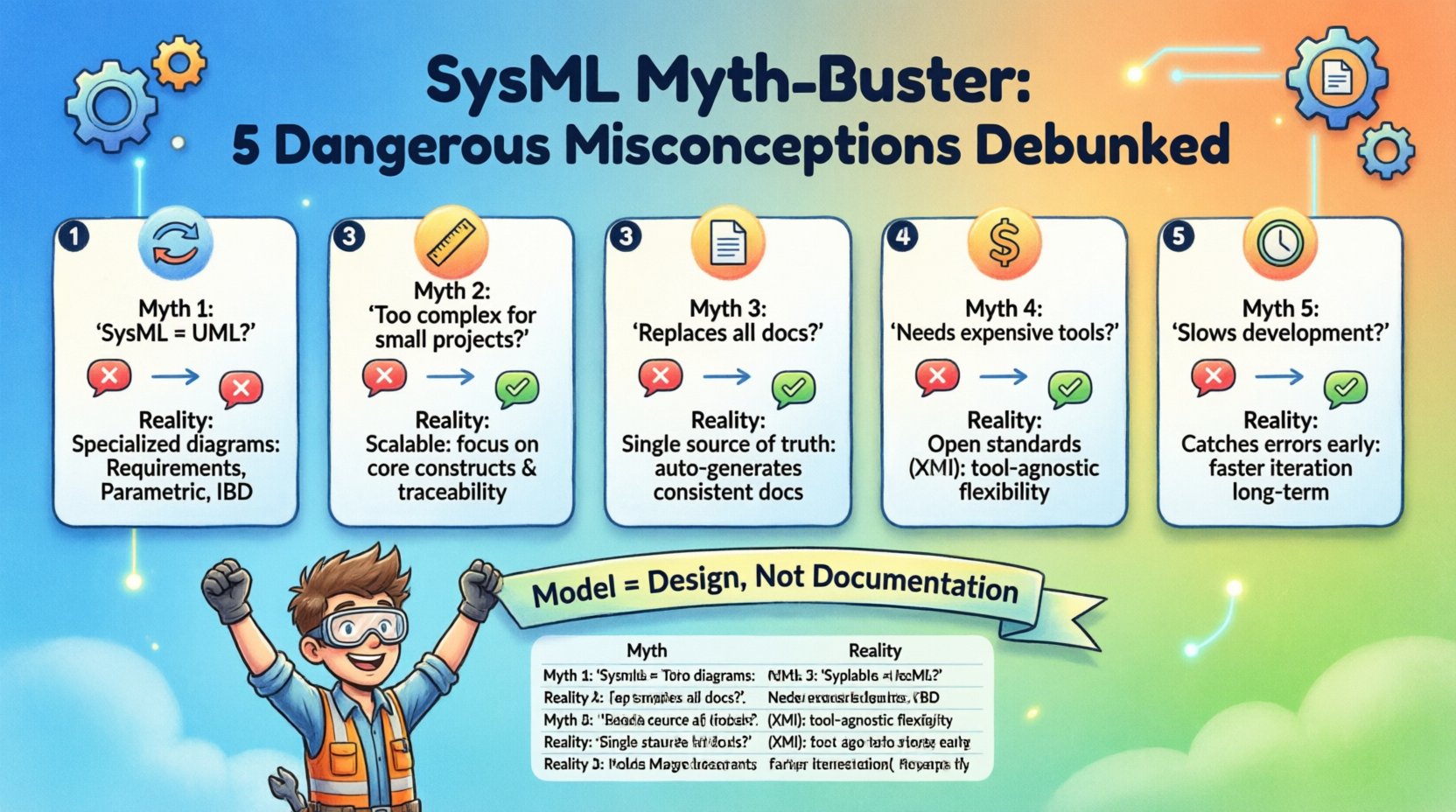
Myth 1: SysML is Just UML for Systems 🔄
One of the most pervasive errors is the belief that SysML is merely a subset of the Unified Modeling Language (UML) with a different name. While UML provided the foundational syntax for object-oriented software, SysML was designed from the ground up to handle the specific challenges of hardware-software integration. It is not simply a renamed UML profile; it is a distinct language with its own semantics and diagram types tailored for system engineering.
Structural Differences
UML focuses primarily on software behavior and class structures. SysML introduces specific constructs that UML lacks or handles poorly. Consider the following distinctions:
Requirements Diagrams: SysML includes a dedicated diagram type for capturing, organizing, and tracing requirements. UML lacks native support for requirement management, often requiring workarounds or external databases.
Parametric Diagrams: System engineering often involves mathematical constraints, physical properties, and performance equations. SysML allows engineers to define constraints using mathematical solvers directly within the model. UML does not support this type of quantitative analysis.
Internal Block Diagrams (IBD): While UML has Sequence and State diagrams, SysML IBDs focus on the flow of materials, energy, and information between internal parts of a block. This is critical for defining interfaces in a physical system context.
Value Properties: SysML explicitly models value properties and flows, which are essential for defining mass, power, and data rates across the system architecture.
Why the Distinction Matters
Assuming SysML is just UML leads to incomplete models. Engineers might attempt to force software-centric patterns onto hardware interfaces, resulting in models that fail to capture physical constraints or material flows. This can lead to integration failures later in the development cycle. Recognizing SysML as a specialized language ensures that the model captures the full scope of the system, including physical and logical aspects.
Myth 2: It is Too Complex for Small Projects 📏
Another common barrier is the perception that SysML is reserved for billion-dollar programs like satellite launches or nuclear reactors. Many smaller engineering teams assume that the overhead of learning the language and building models outweighs the benefits for modest projects. This view misunderstands the scalability of modeling standards.
Scalability of Modeling
Modeling is not an all-or-nothing proposition. The granularity of a SysML model can be adjusted to fit the project scope. For smaller initiatives, engineers can focus on high-level block definitions and requirement allocations without creating detailed internal diagrams for every component.
Focus on Core Constructs: A small project might utilize only the Requirement, Block Definition, and Use Case diagrams. There is no mandate to create parametric or activity diagrams if they do not add value to the specific system.
Traceability Over Detail: The primary value for small teams is often traceability. Ensuring that a requirement is satisfied by a specific design element is possible without modeling every wire or function in minute detail.
Reduced Redundancy: Even in small teams, text documents often become outdated quickly. A single source of truth reduces the time spent updating multiple Word or Excel files.
The Cost of Complexity
Complexity arises when models become disconnected from reality or when the team tries to model everything at once. Proper scoping prevents this. A model that is too detailed becomes a burden to maintain. A model that is too abstract loses its utility. The key is to build the model just enough to provide value, regardless of the project size.
Myth 3: Models Replace All Documentation 📄
There is a fear among regulatory and compliance teams that adopting SysML means abandoning all traditional documentation. This is incorrect. Models do not replace documentation; they transform how it is generated and maintained. The model acts as the system of record, from which documentation can be extracted.
The Single Source of Truth
In traditional workflows, requirements, architecture, and test cases often exist in separate silos. A change in design might not be reflected in the requirements document. In a model-based approach:
Traceability Links: Every requirement is linked to the design elements that satisfy it. If a requirement changes, the impact analysis is immediate.
Automated Reporting: Reports such as Requirements Traceability Matrices (RTM) or Architecture Summaries are generated from the model data. This eliminates manual copy-pasting errors.
Consistency: Since the data exists in one place, the risk of conflicting information between the design document and the requirements document is minimized.
Compliance and Certification
Industries like aviation and medical devices require rigorous documentation for certification. Regulatory bodies accept model-based data, provided the data integrity is maintained. The model itself is not the deliverable in all cases; rather, it is the source from which the deliverables are derived. This ensures that the documentation submitted for certification accurately reflects the actual system design.
Myth 4: Heavy Tooling Investment is Mandatory 💰
Many organizations believe that successful SysML adoption requires expensive, proprietary software licenses immediately. This perception creates a financial barrier to entry. While commercial tools offer robust features, the standard nature of SysML allows for flexibility in tool selection.
Open Standards and Interoperability
SysML is an open standard maintained by the Object Management Group (OMG). This ensures that models are not locked into a single vendor. The language supports interchange formats, such as XMI (XML Metadata Interchange), allowing data to move between different systems.
Tool Agnosticism: Teams can start with open-source or lower-cost modeling environments if they support the standard.
Integration Capabilities: Modern systems often require linking models with simulation tools, code generators, or project management software. A focus on standards ensures these integrations are possible without vendor lock-in.
Long-term Viability: Relying on a single proprietary tool can be risky if the vendor changes pricing or discontinues support. Adhering to the language standard ensures the intellectual property remains accessible.
Strategic Investment
Investment in modeling should be viewed as a strategic capability, not just a software purchase. The cost of the tool is often secondary to the cost of training and process change. A team should evaluate their specific needs before committing to a full-featured commercial suite. Starting with a simpler environment allows the team to mature their modeling practices before scaling up.
Myth 5: Modeling Slows Down Development ⏱️
The most persistent myth is that creating models takes time away from “real” work, slowing down the development cycle. This perspective assumes that modeling is an activity separate from design. In reality, modeling is a form of design. It is the act of thinking through the system before building it.
Early Error Detection
Errors discovered during the testing phase are exponentially more expensive to fix than errors found during the design phase. A formal model allows engineers to:
Verify Consistency: Check if interfaces match on both sides (e.g., sender and receiver).
Simulate Behavior: Run simulations to validate logic before hardware is available.
Identify Gaps: Visualize the system to see missing requirements or dead ends in logic.
Speed of Iteration
While initial setup takes time, the long-term effect is an acceleration of development. Modifying a text document to change a system interface requires manual updates across multiple files. Modifying a model requires updating the relationship once, and the change propagates automatically to all dependent views and reports.
The Feedback Loop
Agile methodologies emphasize rapid feedback. Models support this by providing a visual representation of the system that can be reviewed by stakeholders quickly. This reduces the ambiguity often found in text-heavy specifications. When everyone looks at the same diagram, the discussion is focused on the design intent rather than interpreting the text.
Myth vs. Reality Comparison
To summarize the distinctions between common beliefs and the technical reality, consider the following comparison table.
Misconception | Technical Reality |
|---|---|
SysML is just UML. | SysML includes Requirement, Parametric, and IBD diagrams specifically for systems. |
Only for large projects. | Scalable; can be used for small projects with limited scope. |
Replaces documentation. | Generates documentation; ensures consistency across artifacts. |
Requires expensive tools. | Supports open standards and interchange formats (XMI). |
Slows down development. | Accelerates design by catching errors early and automating updates. |
Implementing Model-Based Systems Engineering Effectively 🛠️
Having addressed the misconceptions, the next step is practical implementation. Successful adoption requires a structured approach to modeling. It is not enough to simply start drawing diagrams; the process must align with the engineering workflow.
Defining the Modeling Standard
Every project needs a modeling standard. This defines which diagram types are mandatory, the naming conventions for blocks and flows, and the rules for traceability. Without a standard, models become inconsistent and unusable. A standard ensures that any engineer on the team can read and understand the work of another.
Diagram Selection: Decide which diagrams are necessary for the project phase.
Notation Rules: Standardize how flows, ports, and interfaces are represented.
Version Control: Integrate model files into the project version control system.
Traceability Management
The core strength of SysML lies in its ability to link requirements to design. A robust traceability strategy ensures that:
Every requirement is allocated to a system element.
Every system element satisfies at least one requirement.
Verification tests are linked to the requirements they validate.
This creates a complete chain of evidence from the initial need to the final verification. It removes the guesswork regarding whether a specific feature is required or tested.
Integration with Other Processes
Modeling does not happen in a vacuum. It must integrate with coding, simulation, and manufacturing processes. For example, code generators can translate specific model elements into programming code. Simulation tools can consume model data to test performance. By ensuring these integrations are part of the plan, the model becomes a central hub for the entire engineering lifecycle.
Looking Forward: The Future of System Modeling 🔮
The landscape of systems engineering continues to evolve. SysML v2 is currently under development to address modern needs, including better support for software integration and improved query capabilities. As the industry moves toward digital twins and cyber-physical systems, the need for precise, executable models will only grow.
Teams that understand the true capabilities of SysML are better positioned to leverage these advancements. Avoiding the myths allows organizations to focus on the actual value proposition: clarity, consistency, and control over complex system architectures. By treating the model as a primary engineering asset rather than a secondary documentation task, teams can achieve higher quality outcomes with greater efficiency.
The decision to adopt these practices is strategic. It requires a commitment to process change and continuous learning. However, the alternative—managing complexity through text alone—often leads to fragmentation and error. Embracing the reality of SysML empowers engineering teams to build systems that are robust, verifiable, and aligned with project goals.