


In the modern enterprise, resources are finite while ambition is boundless. Organizations frequently face a critical challenge: determining which IT initiatives deserve funding and attention. Without a structured approach, technology spending often drifts toward tactical fixes rather than strategic advancement. The Business Motivation Model (BMM) offers a rigorous framework to bridge this gap. By anchoring project selection to defined business motivations, leaders can ensure that every line of code and every infrastructure upgrade contributes directly to organizational value.
This guide details how to leverage BMM criteria to prioritize IT projects effectively. We will explore the core elements of the model, establish a scoring framework, and outline the steps required to maintain strategic alignment over time. The goal is not merely to select projects, but to select the right projects that drive the intended outcomes.
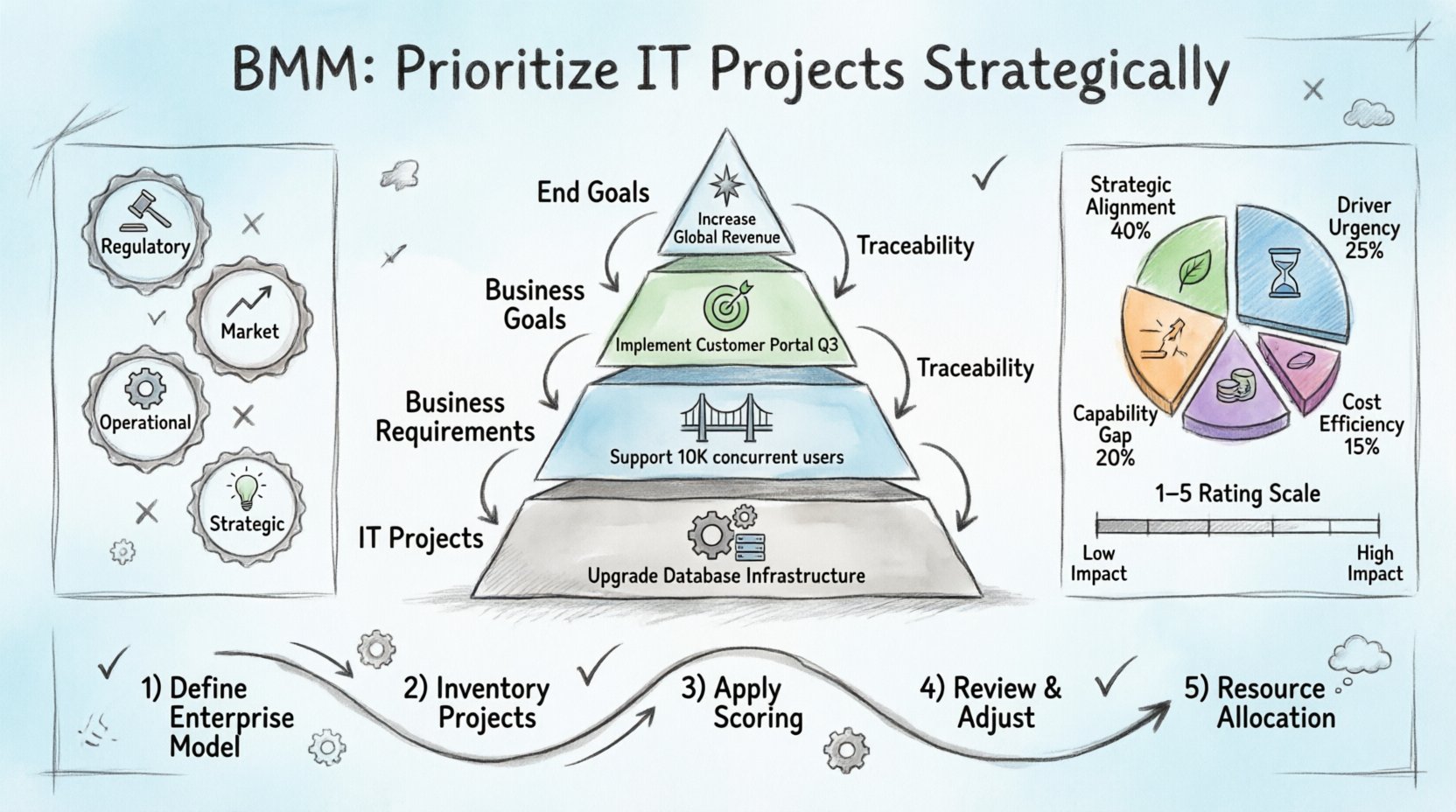
🧩 Understanding the Business Motivation Model Foundation
To prioritize effectively, one must first understand the language of the Business Motivation Model. BMM is an open standard designed to capture the dynamics of business decision-making. It moves beyond simple process mapping to explain why an organization does what it does. For IT project prioritization, understanding the hierarchy of motivation is essential.
- End Goals: These represent the high-level outcomes an organization seeks to achieve. They are the North Star. Examples include “Increase Market Share” or “Reduce Operational Costs by 15%.” IT projects must trace back to these.
- Business Goals: These are specific milestones that contribute to End Goals. They are measurable and time-bound. An example is “Implement Customer Portal Q3.” IT systems often support these directly.
- Business Requirements: These define the specific capabilities needed to achieve the goals. They answer “What must the business be able to do?” IT capabilities map to these requirements.
- Business Drivers: These are internal or external forces that push the organization toward its goals. Examples include regulatory changes, competitor actions, or new technology availability. Drivers dictate urgency.
- Business Influencers: These are factors that affect the achievement of goals but do not directly drive them. They might be stakeholder preferences or cultural norms. They influence the priority ranking.
- Tactics and Actions: These are the specific steps taken to address drivers and meet requirements. IT projects are often collections of these actions.
When prioritizing IT work, the primary filter is the connection between the proposed project and the End Goals. If a project does not support a Business Goal or Requirement, it should face immediate scrutiny. The BMM provides the traceability needed to make this distinction clear.
🎯 Aligning IT Initiatives with Strategic End Goals
Alignment is the bedrock of successful IT investment. Many organizations struggle because IT builds what is technically interesting rather than what is strategically necessary. Using BMM criteria forces a discipline of purpose.
Tracing the Line of Sight
Every IT project must have a documented lineage to a Business Goal. This creates a chain of evidence:
- IT Project: Upgrade Database Infrastructure.
- Business Requirement: Support 10,000 concurrent users.
- Business Goal: Expand into new regional markets.
- End Goal: Increase Global Revenue.
If this chain is broken, the project risks becoming a siloed technical expense. Prioritization begins by auditing existing portfolios against this chain. Projects with weak or non-existent links to End Goals should be deprioritized or cancelled.
Assessing Business Drivers
Not all End Goals are equally urgent. Business Drivers determine the velocity of execution. For instance, a new data privacy regulation might be a stronger driver than a competitor launching a new feature. In the BMM context, drivers add weight to specific goals.
When evaluating IT projects, consider the following driver types:
- Regulatory Drivers: Compliance issues that carry legal risk. These often top the priority list.
- Market Drivers: Customer demand or market trends. These drive revenue opportunities.
- Operational Drivers: Efficiency needs or system stability. These reduce cost and risk.
- Strategic Drivers: Long-term vision shifts. These define future competitiveness.
A project addressing a high-pressure regulatory driver should rank higher than one addressing a low-pressure strategic driver, even if the strategic driver aligns better with long-term revenue. The BMM model allows you to quantify these drivers.
📊 The Prioritization Framework
Once alignment is established, a quantitative framework helps rank competing initiatives. This framework uses BMM criteria to assign scores to potential projects. The following table outlines the core criteria and their definitions.
| Criteria | Definition | Weight |
|---|---|---|
| Strategic Alignment | Direct support of End Goals and Business Goals | 40% |
| Driver Urgency | Pressure from regulatory or market forces | 25% |
| Capability Gap | Criticality of the business requirement | 20% |
| Cost Efficiency | Return on Investment relative to budget | 15% |
Scoring Mechanics
To apply this framework, assign a score from 1 to 5 for each criterion. A score of 5 indicates the highest priority or impact. A score of 1 indicates the lowest. Multiply the score by the weight to get a weighted score.
- Strategic Alignment: Does the project solve a core business problem? If yes, score 5. If it is a nice-to-have, score 2.
- Driver Urgency: Is there a deadline? Is there a legal penalty for delay? High risk equals high score.
- Capability Gap: Is the current system blocking operations? Critical gaps score higher than optimization gaps.
- Cost Efficiency: Calculate the estimated ROI. High value with low cost scores higher than high cost with high value.
This calculation provides an objective baseline. It removes personal bias from the selection process and grounds decisions in the Business Motivation Model.
🔗 Mapping IT Capabilities to Business Requirements
One of the most common failures in IT prioritization is focusing on technology features rather than business capabilities. The BMM distinguishes between the what (Business Requirements) and the how (IT Capabilities). Prioritization must focus on the former.
Identifying the Gap
Before ranking a project, perform a capability gap analysis. Map the proposed IT solution to the specific Business Requirement it intends to satisfy.
- Current State: What capability exists today? Is it manual? Is it automated but slow?
- Future State: What capability is required to meet the Business Goal?
- The Gap: The difference between the two is the scope of the IT project.
If the gap is small, the project may be low priority. If the gap prevents the Business Goal from being achieved, the priority is high. This ensures that IT spending is strictly tied to capability delivery.
Dependency Management
BMM emphasizes that capabilities are often interdependent. A Business Goal might require Capability A and Capability B. Capability A might depend on Capability C.
- Identify dependencies early.
- Do not prioritize Capability B if Capability A is not ready.
- Sequence projects to ensure the capability chain is complete.
Ignoring dependencies leads to stalled initiatives where one part of the business is ready while the supporting IT infrastructure is not. The BMM model helps visualize these relationships, allowing for better sequencing.
🛠️ Executing the Selection Process
Transforming the model into action requires a disciplined process. The following steps outline how to operationalize BMM-based prioritization.
Step 1: Define the Enterprise Model
Before evaluating projects, the organization must define its BMM elements. This includes documenting the current End Goals, Business Goals, and Drivers. If these are vague, prioritization will fail. Ensure all stakeholders agree on the definition of success.
Step 2: Inventory Current Projects
List all active and proposed IT projects. For each, document the primary Business Goal it supports. If a project cannot be linked to a goal, pause the evaluation and request clarification.
Step 3: Apply the Scoring Framework
Use the weighted scoring table described earlier. Conduct a workshop with key stakeholders to assign scores. Ensure that technical leads and business leads participate to balance technical feasibility with business value.
Step 4: Review and Adjust
After scoring, review the results. Look for outliers. If a project with low strategic alignment scores high due to cost, investigate why. If a high-value project scores low due to technical risk, assess if the risk is manageable. Adjust weights if necessary, but document the rationale.
Step 5: Resource Allocation
Once ranked, allocate budget and personnel based on the priority. High-priority projects get the best resources. Lower-priority projects may be delayed or executed with minimal resources. This ensures that the most valuable work is not bottlenecked by resource contention.
⚠️ Navigating Common Organizational Friction
Implementing this model is not without challenges. Organizations often face friction when trying to align IT with business motivation.
Conflicting Goals
Departments often have competing goals. Sales wants speed; Finance wants cost control. In the BMM context, these are conflicting Business Drivers. To resolve this:
- Identify the End Goal that supersedes others.
- Use the Business Drivers to weigh the importance of each departmental goal.
- Make trade-offs explicit rather than hidden.
Political Influence
Stakeholders may push for projects that benefit their department but do not align with the End Goal. This is where the Business Influencers come in. They affect the decision but should not override the Drivers.
- Document the influence of each stakeholder.
- Ensure the scoring framework accounts for objective criteria, not just influence.
- Use the BMM model as an objective authority to counter political pressure.
Changing Priorities
Business environments change. A project that was high priority last quarter may be irrelevant today. The BMM is dynamic. Drivers shift, and Goals evolve.
- Schedule regular reviews (quarterly or bi-annually).
- Re-score projects during these reviews.
- Be willing to cancel projects that no longer align.
Flexibility is a feature of the model, not a bug. Rigidity leads to wasted investment in obsolete initiatives.
📈 Sustaining Alignment Over Time
Prioritization is not a one-time event. It is a continuous cycle of alignment. To maintain the integrity of the BMM approach, organizations must institutionalize the process.
Communication
Share the prioritization logic with the entire organization. When teams understand why a project is prioritized, they are more likely to support the decision. Transparency reduces friction and builds trust.
Metrics and Reporting
Track the outcomes of prioritized projects against the Business Goals they were meant to support. Did the IT investment actually move the needle on the End Goal? If not, analyze the disconnect. Was the goal wrong? Was the project scope incorrect?
- Measure goal achievement, not just project completion.
- Report progress to the executive team regularly.
- Use this data to refine the scoring weights for future cycles.
Training and Adoption
Ensure that project managers and business analysts understand the BMM concepts. They are the ones creating the requirements and linking them to goals. Training ensures that the model is applied correctly from the start.
By embedding the Business Motivation Model into the project lifecycle, organizations create a self-correcting system. Projects that drift from strategy are identified early. Resources are consistently directed toward the highest value activities.
🔍 Deep Dive: The Role of Business Requirements
A critical component of this prioritization strategy is the Business Requirement. In many organizations, requirements are treated as technical specifications. In the BMM context, they are the bridge between motivation and capability.
Quality of Requirements
Poor requirements lead to poor prioritization. If a requirement is vague, it is impossible to score the project accurately. Requirements must be:
- Specific: Clearly defined scope.
- Measurable: Success criteria must be quantifiable.
- Achievable: Realistic given current constraints.
- Relevant: Directly linked to a Business Goal.
- Time-bound: Clear deadlines for delivery.
Requirement Validation
Before a project enters the prioritization pool, the requirements must be validated by the business owner. This ensures that the IT team is solving the right problem. Validation acts as a gatekeeper, preventing low-value work from entering the queue.
When requirements are validated against the BMM, they become a solid foundation for the entire project lifecycle. This reduces the risk of scope creep and ensures that the final deliverable matches the original motivation.
🔄 The Feedback Loop
The process does not end with project selection. The results of executed projects feed back into the Business Motivation Model. This creates a continuous improvement loop.
- Outcome Analysis: Did the project achieve the intended Business Goal?
- Driver Evolution: Did the external environment change, rendering the goal less relevant?
- Capability Refinement: Did the new capability change how the business operates?
This feedback loop ensures that the BMM remains accurate. It allows the organization to adapt its strategy based on real-world results rather than theoretical projections. Prioritization becomes an iterative learning process.
💡 Final Thoughts on Strategic IT Investment
Prioritizing IT projects using the Business Motivation Model requires discipline and clarity. It demands that leaders look beyond the immediate technical needs and focus on the broader business motivation. By mapping projects to End Goals, weighing them against Drivers, and scoring them through a structured framework, organizations can make confident decisions.
The result is a portfolio of IT work that is tightly coupled with business strategy. Resources are not wasted on low-impact initiatives. The organization moves with purpose. While the process requires effort to implement, the return on investment in terms of strategic clarity and resource efficiency is substantial.
Start by defining your End Goals. Document your Drivers. Build your scoring table. Then, begin the work of aligning your IT projects to these foundations. The path to effective IT prioritization is clear, provided you follow the logic of the Business Motivation Model.