


In the modern commercial landscape, stability is often an illusion. Markets shift, technologies emerge, and regulatory environments evolve overnight. Organizations that fail to anticipate these changes risk obsolescence. To build resilience, leaders require a structured approach to understanding strategic intent and the forces that impact it. This is where the Business Motivation Model (BMM) serves as a foundational framework. By mapping the relationships between goals, means, and influencers, businesses can create a clear architecture for navigating uncertainty.
This guide explores how to apply the Business Motivation Model to manage disruption. It moves beyond theoretical concepts to practical application, ensuring that strategic alignment remains intact even when external conditions change. Whether facing technological disruption or economic volatility, a disciplined modeling approach provides the clarity needed to make informed decisions.
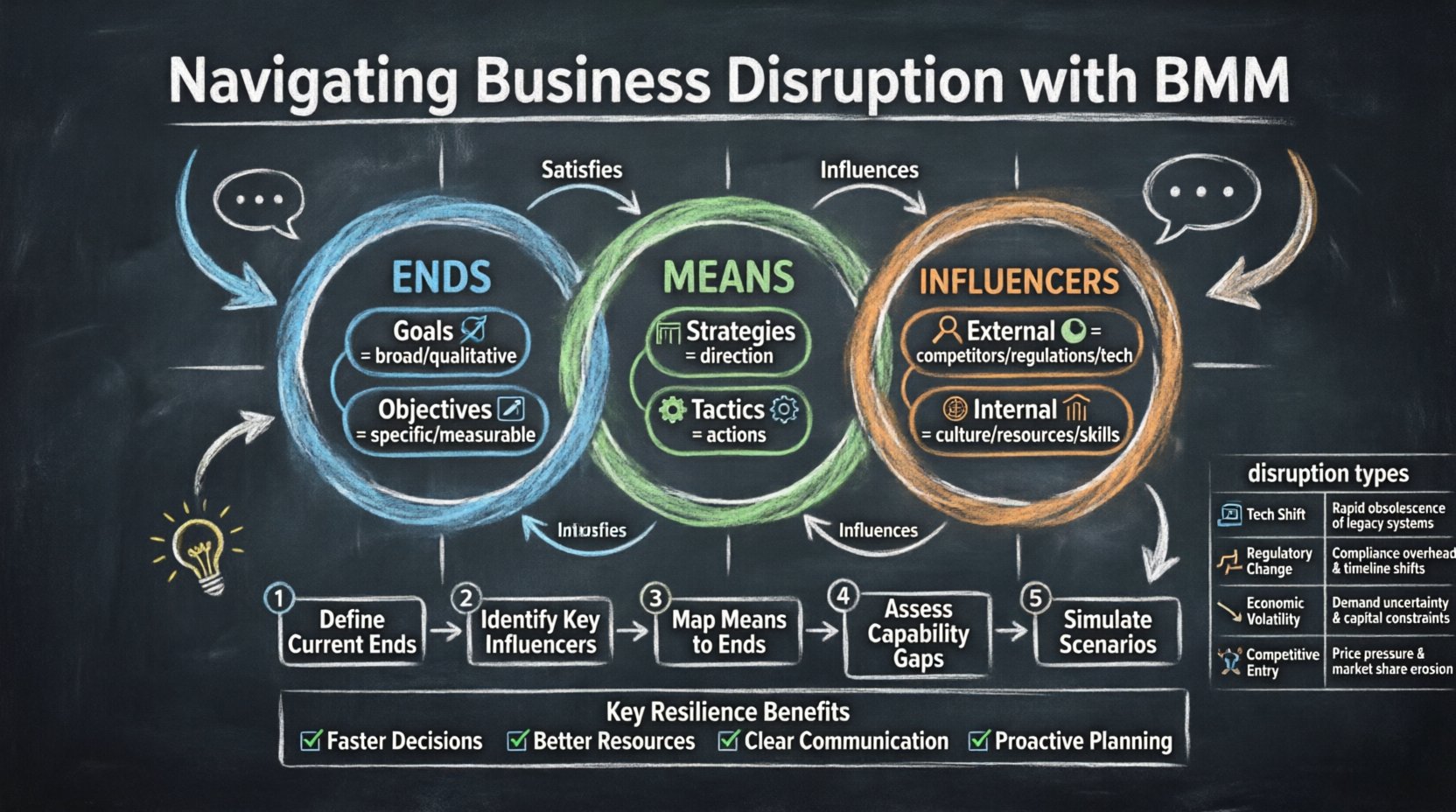
📉 Understanding Business Disruption
Disruption is not merely a change in circumstances; it is a fundamental shift in how value is created and delivered. It often renders existing capabilities insufficient or obsolete. When analyzing disruption, it is crucial to distinguish between incremental changes and transformative events.
- Incremental Change: Adjustments to current processes or minor market shifts. These are often manageable within existing operational structures.
- Transformative Disruption: Events that alter the competitive landscape, such as new entrants, regulatory overhauls, or paradigm-shifting technologies. These require strategic re-evaluation.
Traditional planning methods often focus on linear projections. When disruption occurs, these projections fail because they assume continuity. The Business Motivation Model offers a dynamic view. It does not just plan for the future; it maps the current state of motivation and capability against potential future states.
🧩 Introduction to the Business Motivation Model
The Business Motivation Model is a standardized framework developed to describe the motivation for business activity. It provides a consistent language for business architects and strategists. Unlike software-specific methodologies, this model is technology-agnostic. It focuses on the why, what, and how of organizational intent.
At its core, the BMM separates the reasons for doing something (Ends) from the methods used to do it (Means). This separation is critical when disruption strikes. If the why remains constant, the how can be adapted without losing strategic direction. Conversely, if the why changes, the entire model must be re-evaluated.
🎯 Core Components of BMM
To utilize the framework effectively, one must understand the specific elements that comprise the model. These components interact to create a complete picture of organizational motivation.
1. Ends: Goals and Objectives
Ends represent the desired outcomes. They are what the organization wants to achieve. The BMM distinguishes between two types of Ends:
- Goals: Broad, high-level targets that guide the organization. They are often qualitative and long-term.
- Objectives: Specific, measurable targets that support the broader goals. They are quantitative and often have deadlines.
During periods of disruption, Goals often remain stable, while Objectives may need rapid adjustment. For example, a Goal of “Market Leadership” might remain, but an Objective regarding “Q3 Revenue” might be revised due to market contraction.
2. Means: Strategies and Tactics
Means represent the actions taken to achieve the Ends. This hierarchy includes:
- Strategies: The general approach or plan to achieve an Objective. It defines the direction.
- Tactics: The specific actions or projects executed to implement a Strategy. These are the granular steps.
When disruption occurs, Strategies are often rethought. Tactics may need to be abandoned entirely if they no longer support the current reality. The framework allows teams to trace a specific tactic back to the strategic intent it was meant to support.
3. Influencers
Influencers are external or internal factors that affect the achievement of Ends or the effectiveness of Means. They do not directly drive action but impact the environment.
- External Influencers: Competitors, regulations, economic conditions, technological trends.
- Internal Influencers: Organizational culture, resource availability, employee skills.
In the context of disruption, Influencers are often the catalyst. A change in an Influencer (e.g., a new regulation) forces a change in a Strategy. Identifying which Influencers are volatile is a key step in risk management.
4. Actors and Capabilities
Actors are the entities that perform activities, such as departments, roles, or individuals. Capabilities are the abilities possessed by Actors to perform work. Disruption often highlights a gap between required Capabilities and available Capabilities. The framework helps identify where new skills or resources must be acquired to meet new strategic demands.
📊 Mapping Disruption to BMM Elements
Understanding the theoretical elements is only the first step. The true value lies in mapping disruption scenarios to these elements. The following table illustrates how different types of disruption impact the core components of the Business Motivation Model.
| Disruption Type | Impact on Ends | Impact on Means | Impact on Influencers |
|---|---|---|---|
| Technological Shift | Goals may need to incorporate new digital standards. | Tactics involving legacy systems become obsolete. | Competitors adopting new tech become a threat. |
| Regulatory Change | Objectives may need compliance-specific metrics. | Strategies must include legal review processes. | New laws act as a primary constraint. |
| Economic Volatility | Revenue Goals may shift to cash flow preservation. | Cost-reduction tactics are prioritized over expansion. | Market demand acts as a volatile factor. |
| Competitive Entry | Market share goals may be adjusted. | Marketing strategies require differentiation. | Competitor actions directly impact success. |
This mapping allows leadership to see the ripple effects of a single event. A change in an Influencer does not just require a tactical tweak; it may necessitate a re-evaluation of the Objectives themselves.
🚀 Step-by-Step Framework Application
Applying the Business Motivation Model to navigate disruption requires a disciplined process. It is not a one-time exercise but a continuous cycle of analysis and adjustment. The following steps outline how to operationalize this framework.
Step 1: Define Current Ends
Begin by documenting the current Goals and Objectives. Ensure they are clearly articulated and understood across the organization. Ambiguity here leads to confusion during a crisis. Use the following checklist:
- Are the Goals qualitative or quantitative?
- Are the Objectives measurable and time-bound?
- Do all stakeholders agree on what constitutes success?
Step 2: Identify Key Influencers
List the factors that influence the achievement of these Ends. Categorize them as internal or external. For a disruption scenario, focus heavily on external Influencers that are volatile.
- Monitor market trends continuously.
- Track regulatory announcements.
- Assess competitor movements.
Step 3: Map Means to Ends
Document the Strategies and Tactics currently in place. Map them directly to the Objectives they support. This creates a traceability chain. If a disruption hits a specific Influencer, you can quickly identify which Tactics are at risk and which Strategies might fail.
Step 4: Assess Capability Gaps
Compare the capabilities required to execute the current Means against the capabilities currently available. Disruption often reveals that the organization lacks the necessary skills or resources to pivot. Identify these gaps early to plan for training or hiring.
Step 5: Simulate Scenarios
Use the model to simulate potential disruption scenarios. Ask “What if” questions based on the Influencers identified. If a major competitor enters the market, does the current Strategy hold? If a key resource is lost, can the Objective still be met? This stress-testing prepares the organization for actual events.
🔄 Aligning Ends and Means
One of the most common failures during disruption is the loss of alignment between Ends and Means. Leaders may change the Strategy without realizing the Goal has shifted, or vice versa. The Business Motivation Model enforces alignment through explicit relationships.
The Satisfies Relationship
This relationship connects Means to Ends. A Strategy Satisfies an Objective, and a Goal is satisfied by Objectives. When disruption occurs, check this relationship. Does the new tactic still satisfy the objective? If not, the link is broken, and the strategy needs revision.
The Influences Relationship
Influencers affect Ends and Means. During disruption, the strength of this relationship changes. An Influencer that was once negligible may become critical. The framework allows you to adjust the weight of these relationships. For example, a regulatory change might change an Influencer from “Low Impact” to “Critical Constraint,” forcing a shift in priority.
🛡️ Monitoring and Adapting
Once the model is established, it must be maintained. A static model becomes a hindrance. The business environment is dynamic, and the model must reflect that dynamism.
- Regular Reviews: Schedule periodic reviews of the BMM. Quarterly reviews are often sufficient for stable periods, but monthly reviews may be necessary during high volatility.
- Trigger Points: Define specific thresholds for Influencers that trigger a model review. For instance, if raw material costs rise by 10%, the model is automatically flagged for reassessment.
- Feedback Loops: Establish channels for feedback from the front lines. Those executing the Tactics often see disruption signs before leadership does.
Adaptation is not just about changing the plan; it is about changing the understanding of the situation. The BMM provides the structure to record these changes without losing the historical context of why decisions were made.
⚠️ Common Challenges
Implementing this framework is not without difficulties. Organizations often encounter specific hurdles that can derail the process.
Over-Complication
There is a tendency to create overly detailed models that are difficult to maintain. If the model requires hundreds of hours to update, it will be ignored. Keep the model focused on high-level strategic drivers rather than operational minutiae.
Stakeholder Resistance
Stakeholders may resist the visibility that the BMM brings. When goals and means are mapped, accountability increases. Leadership must foster a culture where transparency is valued over obfuscation.
Static Mindset
The most dangerous pitfall is treating the model as a finished artifact. It must be treated as a living document. If the organization stops updating the Influencers, the model becomes a relic of the past rather than a tool for the future.
🏗️ Building Resilience
The ultimate benefit of using the Business Motivation Model during disruption is resilience. Resilience is the ability to recover quickly from difficulties. By understanding the structural dependencies of the business, organizations can recover faster.
When a disruption hits, resilient organizations do not panic. They consult their architecture. They know which Goals are non-negotiable and which Tactics are expendable. They understand the trade-offs. This clarity reduces decision latency. In a crisis, speed is often as important as accuracy.
Key Benefits of Resilience
- Faster Decision Making: Clear relationships reduce debate over priorities.
- Better Resource Allocation: Resources are directed toward Means that truly support Ends.
- Improved Communication: A shared model provides a common language for strategy execution.
- Proactive Planning: Potential Influencers are identified before they become crises.
🔮 Future-Proofing the Strategy
Looking ahead, the integration of Business Architecture and Motivation Modeling will become increasingly important. As digital transformation accelerates, the gap between strategy and execution widens. The BMM bridges this gap.
Future applications of this framework may involve:
- Automated Monitoring: Using data feeds to update Influencer status automatically.
- Scenario Planning: Creating multiple versions of the BMM for different potential futures.
- Cross-Functional Alignment: Ensuring that IT, Finance, and Operations all map to the same Ends.
While technology evolves, the fundamental need to understand motivation remains constant. The Business Motivation Model provides a stable foundation upon which future strategies can be built.
📝 Summary of Best Practices
To successfully navigate business disruption using the Business Motivation Model, adhere to these core principles:
- Keep it Simple: Focus on high-level drivers rather than low-level details.
- Focus on Ends: Ensure Goals and Objectives are clearly defined and stable where possible.
- Map Relationships: Explicitly document how Means satisfy Ends and how Influencers affect both.
- Review Frequently: Treat the model as a living document subject to regular updates.
- Engage Stakeholders: Ensure all relevant parties understand and contribute to the model.
- Act on Insights: Use the model to drive actual changes in strategy and execution.
By following these practices, organizations can transform disruption from a threat into a manageable variable. The framework does not prevent change, but it provides the structure necessary to navigate it with confidence. In an unpredictable world, structure is the ultimate asset for strategic survival.
The Business Motivation Model offers a path forward. It connects the dots between intention and action. It turns abstract goals into actionable plans. And when the ground shifts beneath your feet, it ensures you know exactly where to stand.