


The modern business landscape operates at a velocity that renders traditional planning cycles obsolete. Market conditions fluctuate with unprecedented speed, driven by technological disruption, regulatory changes, and evolving consumer expectations. For IT leaders, the challenge is no longer just maintaining infrastructure; it is about ensuring that technology investments directly support the evolving strategic needs of the organization. This is where the Business Motivation Model (BMM) becomes an essential framework. By focusing on the why behind business actions, IT strategy can pivot effectively without losing alignment with core organizational objectives.
When market dynamics shift, rigid IT roadmaps often become liabilities. The BMM provides a structured approach to understanding the relationships between business goals, market pressures, and the technical capabilities required to respond. This guide explores how to leverage this model to create a responsive, agile IT strategy that withstands volatility.
🧩 Understanding the Business Motivation Model
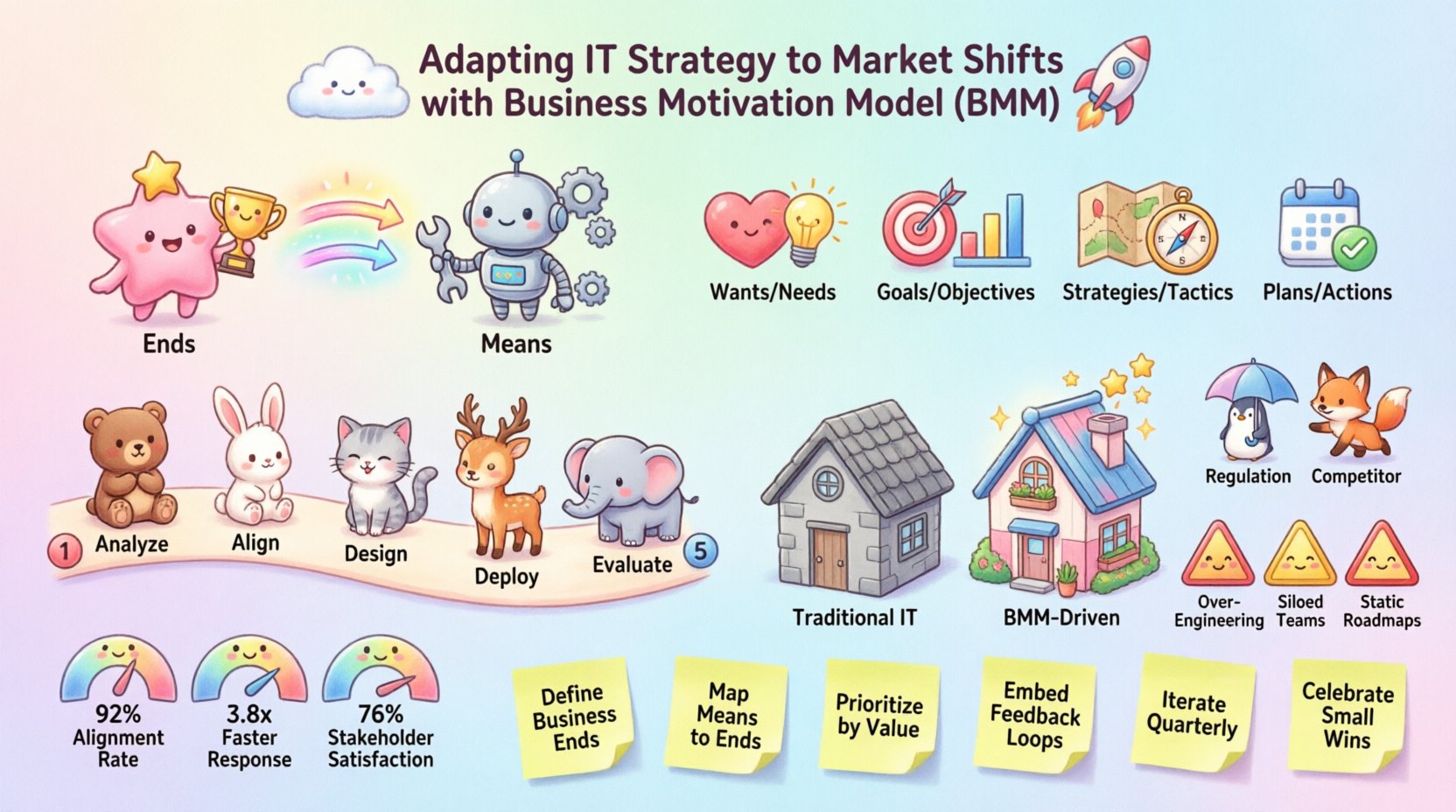
The Business Motivation Model is not merely a diagramming tool; it is a conceptual framework for organizing the factors that drive organizational behavior. It maps out the causal links between what an organization wants to achieve and the actions it takes to get there. In the context of IT strategy, BMM helps clarify the dependencies between high-level business aspirations and the specific technical implementations required to support them.
At its core, the model distinguishes between Ends and Means:
- Ends: These are the goals, objectives, and targets the organization seeks to achieve. They represent the desired outcomes.
- Means: These are the strategies, tactics, plans, and actions taken to realize the Ends. They represent the execution path.
By clearly defining these elements, IT leaders can avoid the common pitfall of building technology for technology’s sake. Instead, every server provisioned, every software license acquired, and every architecture decision is traced back to a specific business motivation.
📉 Why IT Strategy Needs to Pivot
Market shifts do not announce themselves with a warning label. They emerge as gradual changes in customer behavior, sudden regulatory updates, or the appearance of disruptive competitors. When these shifts occur, an IT strategy that was built on static assumptions often fails.
Consider the following scenarios where traditional IT planning falls short:
- Customer Behavior Changes: If consumers suddenly shift to mobile-first interactions, a strategy built on desktop-heavy infrastructure creates friction.
- Regulatory Compliance: New data privacy laws require immediate changes in how data is stored and processed, often invalidating existing architecture patterns.
- Competitive Pressure: A competitor launches a feature that changes the industry standard, forcing a rapid response in product delivery capabilities.
In these instances, the question is not just can the IT department adapt, but how can it adapt without breaking existing services or wasting budget on irrelevant solutions. The BMM addresses this by forcing a review of the underlying motivations whenever a shift occurs.
⚙️ Core Components of BMM for IT Alignment
To adapt IT strategy effectively, one must understand the specific elements of the model and how they interact. These components form the backbone of the alignment process.
1. Wants and Needs
These represent the drivers of change. Wants are the high-level desires of stakeholders (e.g., “We want to reduce time-to-market”). Needs are the specific conditions required to satisfy those wants (e.g., “We need automated testing environments”). IT must map technical capabilities to these specific needs.
2. Goals and Objectives
Goals are the broad directions (e.g., “Improve customer satisfaction”). Objectives are measurable targets (e.g., “Reduce support ticket resolution time by 20%”). IT systems must be configured to track and contribute to these metrics.
3. Strategies and Tactics
Strategies are the high-level approaches (e.g., “Adopt cloud-native architecture”). Tactics are the specific steps taken to execute the strategy (e.g., “Migrate database services to a managed cloud provider”).
4. Plans and Actions
Plans are the schedules and resource allocations. Actions are the actual tasks performed by individuals or systems. IT operations must ensure that actions taken align with the strategic intent.
🔄 Bridging the Gap: Aligning IT with Business Motivation
Aligning IT with business motivation requires a deliberate process. It involves translating abstract business desires into concrete technical requirements. The following steps outline this alignment process.
Step 1: Identify Strategic Drivers
Begin by cataloging the external and internal factors influencing the business. This includes market trends, competitor actions, and internal efficiency goals. Document these as Wants.
Step 2: Define Business Needs
For each Want, define the specific Needs. If the Want is “Faster Product Launch,” the Need might be “Continuous Integration Pipeline.” This step prevents vague requirements.
Step 3: Map Technical Capabilities
Identify the current and potential technical capabilities that can fulfill these Needs. This is where IT architecture comes into play. Evaluate whether existing infrastructure supports the Needs or if new capabilities are required.
Step 4: Establish Metrics
Define how success will be measured. Use Goals and Objectives to set KPIs that reflect both business value and technical performance.
Step 5: Continuous Review
Market conditions change. Regularly review the motivations. If a Want is no longer relevant, the associated technical investments should be reassessed or terminated.
📊 Traditional vs. BMM-Driven IT Strategy
Understanding the difference between traditional planning and a BMM-driven approach helps clarify the value of this model. The table below highlights key distinctions.
| Aspect | Traditional IT Strategy | BMM-Driven IT Strategy |
|---|---|---|
| Focus | Technology delivery and uptime | Business value and motivation alignment |
| Planning Horizon | Fixed annual cycles | Dynamic, event-driven adjustments |
| Decision Making | Based on technical feasibility | Based on strategic relevance |
| Response to Change | Reactive and costly | Proactive and traceable |
| Stakeholder Engagement | IT defines requirements | Business defines motivation, IT enables |
🌍 Handling Market Shifts with BMM
When a market shift occurs, the BMM provides a structured way to assess the impact on IT. Instead of scrambling to fix problems, the organization evaluates the shift against the established model.
Scenario: Sudden Regulatory Change
Suppose a new data regulation is announced. A traditional approach might immediately allocate budget for compliance software. A BMM approach would analyze the change as follows:
- Update Wants: Does the regulation create a new Want (e.g., “Ensure full compliance”)?
- Update Needs: What specific data handling capabilities are now required?
- Re-evaluate Strategies: Do current strategies for data storage align with the new regulatory reality?
- Adjust Actions: Modify technical actions to ensure data flows through compliant channels.
This ensures that the IT response is not just a patch but a strategic adaptation. It prevents over-investment in areas that do not address the core motivation of compliance while ensuring critical risks are managed.
Scenario: Competitor Innovation
If a competitor introduces a feature that becomes an industry standard, the BMM helps IT assess whether to adopt similar capabilities.
- Assess the Want: Is customer expectation shifting to require this feature?
- Check the Goal: Does having this feature support the business goal of market share growth?
- Resource Allocation: Do we have the technical capacity to build or acquire this capability without compromising other strategic objectives?
📏 Key Metrics for Success
Measuring the effectiveness of a BMM-driven strategy requires metrics that bridge the gap between business outcomes and IT performance. Relying solely on technical uptime is insufficient.
Strategic Alignment Metrics
- Goal Achievement Rate: Percentage of business goals supported by active IT projects.
- Strategic Initiative Velocity: How quickly can IT pivot resources to new strategic priorities?
- Requirement Traceability: Percentage of technical features linked to a specific business motivation.
Operational Performance Metrics
- Resource Utilization Efficiency: Are technical resources being used for high-value activities?
- Change Request Impact: How does the frequency of changes correlate with market shifts?
- Time-to-Value: How long does it take from identifying a business need to delivering a technical solution?
⚠️ Common Pitfalls in Strategic Alignment
Even with a robust model, organizations often stumble during implementation. Recognizing these pitfalls early can save significant time and resources.
1. Over-Modeling
Creating a BMM that is too complex can paralyze decision-making. If every action requires a detailed justification within the model, agility is lost. Keep the model high-level where possible and drill down only for critical decisions.
2. Ignoring the Human Element
Technology is delivered by people. If the Wants of the business do not align with the motivations of the IT team, adoption will fail. Ensure that IT staff understand how their work contributes to the broader business goals.
3. Static Documentation
A common mistake is treating the BMM documentation as a one-time exercise. The model must be living documentation. If the market shifts, the model must be updated immediately.
4. Disconnecting Means from Ends
Organizations often focus heavily on Means (tools, processes) and lose sight of Ends (outcomes). Regularly audit projects to ensure they are still serving the original motivation.
🔮 Future-Proofing Your IT Roadmap
The landscape of technology will continue to evolve. Artificial intelligence, edge computing, and decentralized systems will introduce new variables into the business motivation model. To future-proof the IT strategy, the organization must build a culture of continuous alignment.
This involves establishing a governance body that regularly reviews the BMM. This group should include both business leaders and IT architects. Their role is to ensure that the Wants of the business remain consistent with the Means available in the IT landscape.
Additionally, investing in modular architecture supports this adaptability. When systems are built as interchangeable components, the Actions taken by IT can be modified without dismantling the entire infrastructure. This technical flexibility mirrors the strategic flexibility required by the BMM.
🛠️ Implementation Checklist
To begin integrating the Business Motivation Model into your IT strategy, follow this checklist.
- Identify Stakeholders: Who defines the business goals? Who defines the technical constraints?
- Document Current Motivations: Create a baseline of current Ends and Means.
- Map Current Projects: Link existing IT initiatives to the documented motivations.
- Identify Gaps: Where are there motivations without technical support? Where is there technology without clear motivation?
- Establish Review Cadence: Set a schedule for reviewing the model against market conditions.
- Train Teams: Ensure IT and business teams understand the language of the model.
🤝 The Path Forward
Adapting IT strategy to market shifts is not a one-time project but an ongoing discipline. The Business Motivation Model offers a proven structure to maintain that discipline. By anchoring technical decisions in clear business motivations, organizations can navigate volatility with confidence.
The goal is not to predict the future with certainty, but to build a system that can respond to whatever the future brings. When IT strategy is driven by motivation rather than just technology, the organization gains a resilience that pure engineering cannot provide. This alignment turns IT from a cost center into a strategic engine, driving value through every market cycle.
Start by mapping your current motivations. Review your technical stack against them. Adjust as needed. The market will shift again, but with this framework, your strategy will shift with it.