


Effective strategy execution relies on more than just planning; it requires alignment. When stakeholders operate with different interpretations of objectives, performance suffers. The Business Motivation Model (BMM) offers a standardized framework to bridge this gap. By defining clear relationships between actors, goals, and obstacles, organizations can achieve a shared understanding of their direction. This guide explores how to leverage this model to foster clarity across enterprise architecture.
🔍 The Challenge of Misalignment
Organizations often face a disconnect between high-level strategy and day-to-day execution. Executives define broad visions, while operational teams focus on immediate tasks. Without a common language, these two layers drift apart. This misalignment leads to wasted resources, duplicated efforts, and frustration.
Key symptoms of poor goal understanding include:
- Conflicting Priorities: Department A optimizes for cost, while Department B optimizes for speed, causing friction.
- Ambiguous Metrics: Teams measure success differently, making it hard to report progress accurately.
- Lost Context: New hires or external partners struggle to understand why certain initiatives matter.
- Resistance to Change: Stakeholders reject new directives because they do not see the link to long-term value.
The Business Motivation Model provides a structured way to document these relationships. It moves beyond simple lists of tasks and connects the “why” to the “what” and the “how”.
🏗️ Core Concepts of the Business Motivation Model
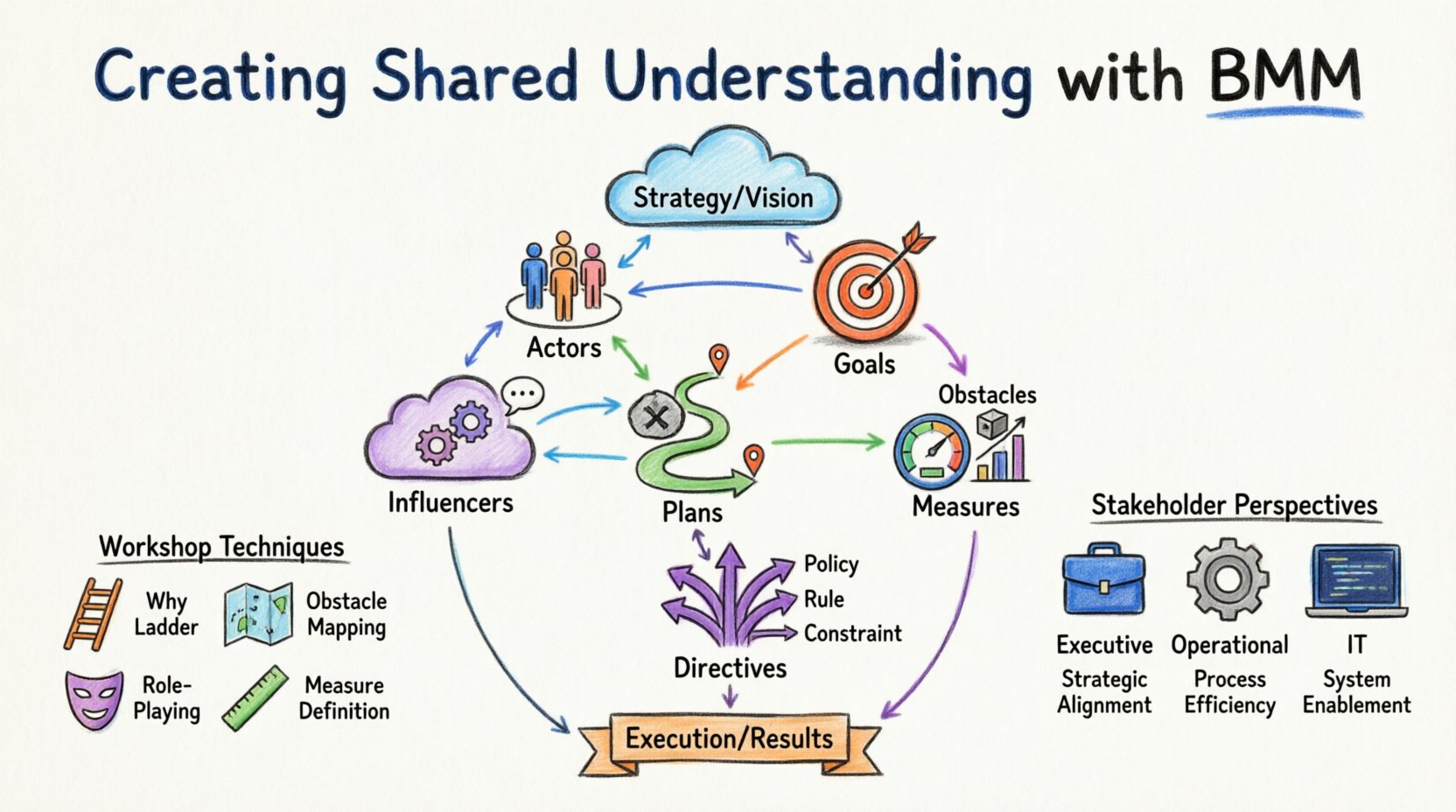
BMM is an object-oriented model that describes the motivations of an enterprise. It is maintained by the Object Management Group (OMG) and serves as a foundation for business architecture. The model distinguishes between the motivating factors and the actions taken to address them.
To create shared understanding, one must first understand the fundamental building blocks. These elements interact to form a coherent picture of organizational intent.
1. Actors
Actors are the entities capable of performing actions. This includes people, roles, departments, or even external organizations. In a workshop setting, identifying who participates is the first step. Every goal must have an owner or a beneficiary.
2. Goals
Goals represent what an actor wants to achieve. They can be abstract (e.g., “Market Leadership”) or concrete (e.g., “Increase Revenue by 10%”). Goals are the central focus of the model. Shared understanding requires that every goal is clearly defined in terms of its scope and intent.
3. Obstacles
Obstacles are factors that prevent an actor from achieving a goal. These could be external (market conditions) or internal (legacy systems). Identifying obstacles early helps in planning mitigation strategies.
4. Influencers
Influencers are factors that affect an actor, goal, or obstacle but do not directly prevent or enable them. They provide context. For example, a regulatory change is an influencer that affects goals but is not an obstacle itself.
5. Plans
Plans are the courses of action taken to achieve goals. They break down high-level objectives into manageable steps. A plan connects the motivation to the execution.
6. Measures
Measures quantify the achievement of a goal. They provide the data needed to validate progress. Without measures, a goal remains a vague aspiration.
7. Directives
Directives are instructions given by an actor to another actor or to a system. They drive the execution of plans.
🤝 Facilitating Shared Understanding
Building a model on paper is not enough. The real value lies in the collaborative process of creating it. The goal is to get stakeholders in a room (virtual or physical) and agree on the definitions.
Step 1: Preparation and Scope
Before gathering the team, define the scope of the modeling effort. Are you modeling the entire enterprise or a specific business unit? Clear boundaries prevent scope creep. Select participants who represent different viewpoints, including strategy, operations, and IT.
Step 2: Defining the Vocabulary
Ensure everyone agrees on the terminology. A “Goal” in one department might mean a “Task” in another. Create a glossary or use the BMM standard definitions strictly. This reduces ambiguity during the discussion.
Step 3: Visualizing Relationships
Use diagrams to map the connections. Visuals help stakeholders see the big picture. Focus on the links between:
- Actors and their Goals
- Goals and their Obstacles
- Goals and their Measures
When stakeholders see how their specific objectives link to the broader strategy, ownership increases.
Step 4: Validation and Refinement
Once the initial model is built, validate it against reality. Do the plans actually support the goals? Do the measures accurately reflect success? This is an iterative process. The model evolves as the business changes.
📊 BMM Elements and Stakeholder Perspectives
Different stakeholders care about different parts of the model. Understanding these perspectives helps tailor the communication of the shared goals.
| BMM Element | Executive Perspective | Operational Perspective | IT Perspective |
|---|---|---|---|
| Goal | Strategic alignment and ROI | Daily targets and KPIs | System capabilities to support goals |
| Obstacle | Risk to market position | Daily blockers | Technical debt or integration issues |
| Plan | Strategic initiatives | Work schedules | Release cycles and deployments |
| Measure | Quarterly financial results | Weekly productivity metrics | System uptime and performance |
| Actor | Board and Leadership | Team Leads and Staff | Developers and Architects |
By mapping these perspectives, you can ensure that the shared understanding resonates across all levels of the organization.
🛠️ Techniques for Alignment Workshops
Workshops are the primary vehicle for building this understanding. They require structure to be effective. Below are techniques to guide the session.
Technique 1: The “Why” Ladder
Ask “Why is this important?” repeatedly until you reach a fundamental motivation. This traces a goal back to its root cause. It helps verify that the goal is not just a task disguised as a strategy.
Technique 2: Obstacle Mapping
Brainstorm everything that could stop the goal from being achieved. This encourages critical thinking and risk management. It moves the conversation from optimism to realism.
Technique 3: Role-Playing Actors
Assign participants to specific actors (e.g., “Customer,” “Regulator,” “Sales Team”). Ask them to define their goals and obstacles. This builds empathy and reveals conflicting interests early.
Technique 4: Measure Definition
Challenge the team to define how success is measured for every goal. If a goal cannot be measured, it may need to be refined. This ensures accountability.
🚧 Common Pitfalls and How to Avoid Them
Even with a structured model, teams can stumble. Being aware of common traps helps maintain momentum.
- Over-Modeling: Trying to model every single detail at once creates paralysis. Start with the top-level strategic goals and expand gradually.
- Ignoring Influencers: Focusing only on obstacles misses external factors that shape the environment. Include market trends and regulatory changes.
- Lack of Ownership: Goals without assigned actors are just suggestions. Ensure every goal has a clear owner who is accountable for its achievement.
- Static Documentation: Treating the model as a one-time deliverable. The model must be living documentation that updates with business changes.
- Confusing Plans with Goals: A plan is how you get there; a goal is where you are going. Keep them distinct to maintain clarity on the destination.
📈 Sustaining Alignment Over Time
Creating shared understanding is not a one-time event. It is a continuous discipline. As the business environment shifts, goals may need to pivot. The BMM framework supports this agility.
Regular Reviews
Schedule periodic reviews of the model. During these sessions, ask:
- Are the goals still relevant?
- Have new obstacles emerged?
- Do the measures still reflect value?
Communication Channels
Disseminate the model through regular reports and dashboards. When stakeholders see their contributions linked to the model, engagement remains high. Use the visual diagrams to explain changes in strategy to new employees.
Integration with Planning Cycles
Embed the BMM elements into existing planning processes. When budgeting or resource allocation happens, reference the goals and plans defined in the model. This ensures resources flow toward the intended outcomes.
🔗 Connecting Strategy to Execution
The ultimate value of this approach is the connection between high-level intent and low-level action. When a developer writes code, they should know which business goal it supports. When a salesperson pitches, they should understand the strategic obstacle they are helping to overcome.
This connection reduces waste. Effort is directed only toward activities that contribute to the defined goals. Decisions are made based on their impact on the model, rather than gut feeling. This creates a culture of evidence-based management.
🛠️ Implementation Roadmap
For teams ready to adopt this approach, consider the following roadmap.
- Assess Current State: Identify where communication breakdowns occur. Map existing goals and see if they are documented consistently.
- Train the Team: Provide training on BMM concepts. Ensure everyone understands the terminology.
- Pilot a Project: Select a single business unit or project to model first. Success here builds confidence for wider adoption.
- Establish Governance: Define who is responsible for maintaining the model. Create a change management process for updates.
- Scale Gradually: Expand the model to other areas of the enterprise as the initial pilot proves successful.
🌟 Conclusion
Achieving shared understanding of goals is a critical capability for any mature organization. The Business Motivation Model provides the structure and language necessary to align diverse stakeholders. By focusing on actors, goals, obstacles, and measures, teams can move from fragmented efforts to cohesive execution. The process requires discipline and collaboration, but the result is a clearer path to value. Organizations that master this alignment gain a significant advantage in navigating complex markets and delivering consistent results.