


Leadership teams often face a persistent challenge: bridging the gap between complex technical initiatives and high-level business value. When a Chief Information Officer presents a roadmap involving microservices, cloud migration, or data governance, the response from the C-Suite can range from confusion to skepticism. This disconnect occurs not because technology is irrelevant, but because the language used to describe it does not align with the objectives that drive the organization forward. To resolve this, we must adopt a structured framework that translates technical effort into business outcomes. The Business Motivation Model (BMM) offers a robust methodology for this alignment.
This guide explores how to leverage the Business Motivation Model to communicate technology strategy effectively to non-technical executives. By focusing on Ends and Means, we can ensure that every line of code and infrastructure decision supports the core mission of the enterprise. We will examine the core components of BMM, demonstrate how to map technical capabilities to business goals, and provide a practical framework for structuring your strategic presentations.
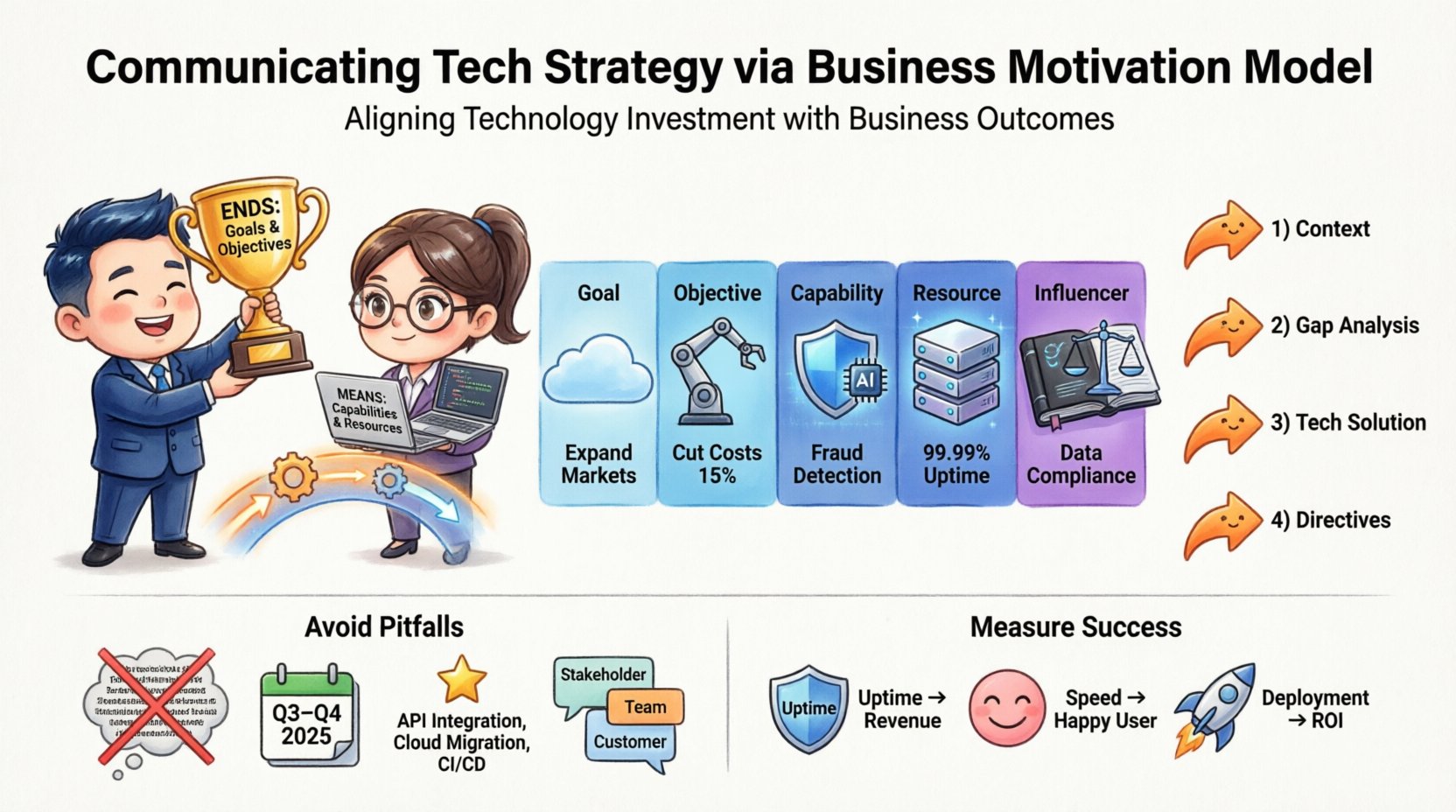
🧠 Understanding the Business Motivation Model Framework
The Business Motivation Model is a standardized framework used in enterprise architecture to describe the structure of motivation within a business. It provides a vocabulary for stakeholders to discuss why a business exists and how it intends to achieve its purpose. For technology strategists, BMM acts as a translation layer. It moves the conversation away from how technology works and focuses on why it is being deployed.
At its core, BMM distinguishes between two fundamental categories:
- Ends: These are the goals and objectives of the organization. They represent what the business wants to achieve. Ends are categorized into Goals (broad, qualitative targets) and Objectives (specific, measurable targets).
- Means: These are the capabilities and resources required to achieve the Ends. Means are categorized into Capabilities (skills, processes, or functions) and Resources (people, systems, or assets).
When presenting technology strategy, executives are primarily concerned with Ends. They want to know how the investment will impact revenue, market share, or operational efficiency. Technology, in this context, belongs to the Means. By explicitly mapping technology initiatives to specific business goals, you ground your strategy in the reality of the organization’s success.
🔍 Why Executives Need the Business Motivation Model
Non-technical executives operate in an environment defined by risk, resource allocation, and market dynamics. They do not have the bandwidth to understand the intricacies of a specific database architecture or the latency implications of a network protocol. Their primary concern is the alignment of resources with the strategic vision. The Business Motivation Model addresses this need in three critical ways.
1. Establishing a Common Vocabulary
Without a shared framework, the CIO speaks of API gateways while the CFO speaks of cost avoidance. BMM creates a unified lexicon. Instead of discussing a new server infrastructure, you discuss a new Capability that enables a Goal of improved customer responsiveness. This linguistic shift reduces friction and fosters collaboration.
2. Clarifying Value Propositions
Every technology project requires funding. To secure that funding, the value must be clear. BMM forces the strategist to identify the specific End that the technology serves. If a technology initiative cannot be traced back to a specific Goal or Objective, it lacks strategic justification. This discipline ensures that budget requests are tied directly to organizational success metrics.
3. Managing Influencers and Risks
BMM includes a component for Influencers, which are external or internal factors that impact the achievement of Ends. This includes regulatory changes, market shifts, or competitor actions. By presenting technology strategy through BMM, you acknowledge that technology does not exist in a vacuum. You demonstrate to executives that you understand the broader context and have accounted for the factors that could hinder progress.
🔗 Mapping Technical Capabilities to Business Value
The most effective way to communicate strategy is to visualize the connection between technology and business outcomes. Below is a framework for mapping technical elements to business motivation components. Use this table to structure your own planning documents.
| BMM Component | Business Perspective (Ends) | Technical Perspective (Means) | Communication Focus |
|---|---|---|---|
| Goal | Expand into new geographic markets | Multi-region cloud deployment | Enable local latency and compliance |
| Objective | Reduce operational costs by 15% | Automated infrastructure provisioning | Eliminate manual overhead |
| Capability | Real-time fraud detection | Machine learning pipeline integration | Minimize financial loss per transaction |
| Resource | Ensure 99.99% system availability | Redundant server clusters | Guarantee uptime for revenue generation |
| Influencer | Compliance with new data laws | Encryption standards upgrade | Avoid legal penalties and reputation damage |
When presenting this data, avoid listing the technical components first. Start with the Goal. For example, do not say, “We are migrating to Kubernetes.” Instead, say, “To achieve our Goal of faster product deployment, we are implementing a container orchestration platform.” The technology becomes the solution to the business problem, not the problem itself.
🛡️ Addressing Influencers and Barriers
In the Business Motivation Model, Influencers are elements that can positively or negatively impact the achievement of Ends. For technology strategy, these often manifest as risks or opportunities. Executives appreciate transparency regarding these factors. They prefer to know about potential roadblocks early so they can allocate resources accordingly.
When discussing Influencers, categorize them clearly:
- Internal Influencers: These are factors within the organization. Examples include legacy system dependencies, skill gaps in the current workforce, or budget constraints. You can mitigate these through training programs or phased migration strategies.
- External Influencers: These are factors outside the organization. Examples include regulatory changes, supply chain disruptions, or emerging competitor technologies. These require monitoring and adaptive planning.
By explicitly identifying Influencers in your strategy presentation, you demonstrate maturity. You are not promising a perfect outcome; you are promising a managed path toward the goal. This builds trust with leadership, as they see that you have considered the full scope of the challenge.
📢 Structuring the Strategic Narrative
Once the mapping is complete, the next step is to structure the narrative. A technology strategy presentation should not read like a technical manual. It must follow a logical flow that mirrors the decision-making process of the executives.
Step 1: Define the Strategic Context
Begin by restating the organizational Goals. Remind the audience of the high-level objectives the company is pursuing for the next fiscal year. This ensures everyone is aligned on the destination before discussing the vehicle used to get there.
Step 2: Present the Gap Analysis
Explain the difference between the current state and the desired state. Use the BMM framework to highlight which Capabilities are missing. For instance, “Our current capability for data analytics does not support the Goal of predictive customer engagement. We have a gap in our means.”
Step 3: Propose the Technical Means
Introduce the technology strategy as the solution to the identified gap. Describe the new Capabilities and Resources required. Keep the technical detail high-level unless specifically requested. Focus on the function the technology provides, not the implementation details.
Step 4: Outline the Directives
In BMM, Directives are the decisions and plans that drive the Means toward the Ends. Clearly state the next steps. What decisions need to be made? What approvals are required? What is the timeline? Executives need to know where their input is needed to move the strategy forward.
⚠️ Common Pitfalls in Communication
Even with a solid framework like BMM, communication can fail if specific pitfalls are not avoided. Being aware of these common errors will help you maintain clarity and authority.
- Using Jargon as a Shield: Avoid using technical acronyms to obscure the truth. If you use terms like latency, throughput, or schema, define them immediately in business terms. If you cannot explain a concept without jargon, you may not understand its value well enough to communicate it.
- Ignoring the Timeline: Technology projects often take longer than business leaders expect. Be realistic about the duration of the Means implementation. Overpromising delivery dates erodes trust. Use BMM to show the phased nature of capability development.
- Focusing on Features over Outcomes: Do not list features of a new system. List the outcomes those features enable. A feature is a thing the system does; an outcome is a value the business receives. Always prioritize the outcome.
- One-Way Communication: Strategy is not a monologue. Use the presentation as a starting point for dialogue. Ask executives about their specific concerns regarding the Influencers you have identified. Their insights can refine the strategy.
🔄 Establishing Feedback Loops
Communication of technology strategy is not a one-time event. It is a continuous process of alignment. The Business Motivation Model supports this through the concept of Feedback. As the business environment changes, the Ends may shift, requiring adjustments to the Means.
To maintain alignment, establish regular review cycles. These should not be technical status meetings. They should be strategic alignment meetings where you review:
- Has the Goal changed due to market conditions?
- Are the current Capabilities still sufficient to meet the Objective?
- Have new Influencers emerged that require a change in the Directives?
By institutionalizing these reviews, you position the technology function as a strategic partner rather than a utility provider. You show that you are agile and responsive to the needs of the business.
📈 Measuring Strategic Success
Finally, how do you know if the technology strategy is working? In the BMM context, success is measured by the achievement of Ends, not the completion of technical tasks. You must define metrics that reflect business value.
Consider the following examples of technical metrics translated into business value:
- Technical: 99.9% Uptime. Business Value: Revenue protection during peak sales periods.
- Technical: API Response Time under 200ms. Business Value: Improved user satisfaction and retention rates.
- Technical: Deployment Frequency increased by 50%. Business Value: Faster time-to-market for new products.
When reporting progress, lead with the business value. If a technical milestone is missed, explain how it impacts the business Goal. If a milestone is met, explain how it contributes to the Objective. This ensures that every report reinforces the connection between IT investment and business performance.
🤝 Conclusion
Communicating technology strategy to non-technical executives requires a shift in perspective. It requires moving from a focus on implementation to a focus on motivation. The Business Motivation Model provides the structure necessary for this shift. By clearly defining Ends, mapping Means, and managing Influencers, you create a narrative that resonates with leadership.
This approach does more than just secure approval for projects. It fosters a culture of alignment where technology and business are understood as a single, integrated engine for growth. When executives understand that technology is a Mean to achieve a Goal, the conversation changes from cost center management to strategic investment. Adopting this framework empowers technology leaders to speak the language of the boardroom and drive the organization toward its highest potential.
Start by auditing your current strategy documentation against the BMM components. Identify where the links between technology and business goals are weak. Strengthen these links, and you will find that the path to strategic approval becomes clearer and more direct.