


Communication gaps between technology teams and business leadership often stall progress. Engineers speak in protocols, latency, and architecture patterns. Executives speak in revenue, risk, market share, and customer satisfaction. When these two groups do not understand each other, strategy suffers. The Business Motivation Model (BMM) offers a structured framework to bridge this divide. It provides a common language to map technical activities to business intent.
This guide explores how to use BMM to translate technical complexity into business value. By aligning technical initiatives with organizational goals, leaders can make informed decisions without needing deep technical expertise.
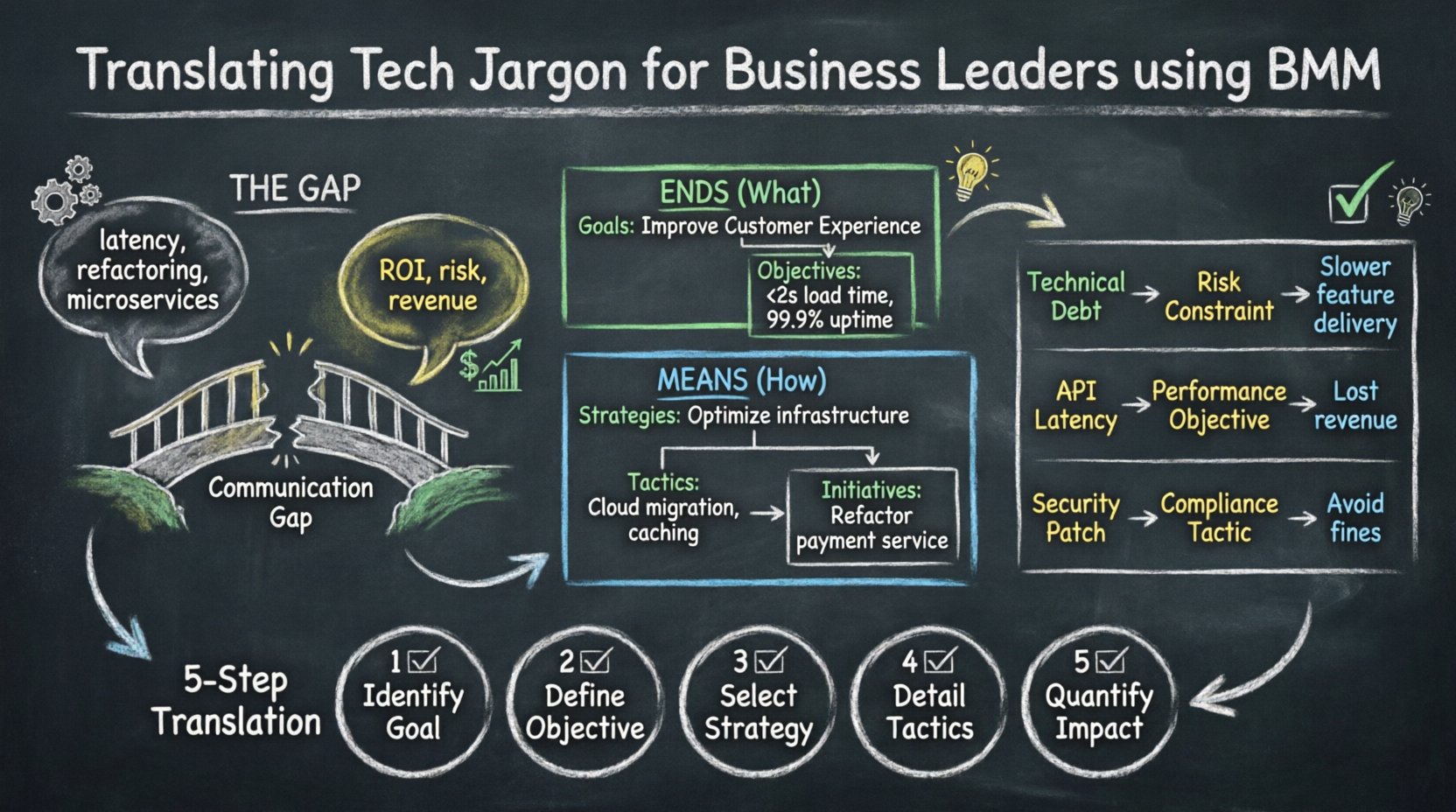
Understanding the Communication Gap 🚧
In many organizations, technical teams propose solutions based on efficiency or stability. Leadership evaluates proposals based on ROI and speed to market. Without a translation layer, technical details are often dismissed as noise or cost centers. Conversely, business requests can seem vague to engineers, leading to scope creep or misaligned deliverables.
Common barriers include:
- Abstraction Levels: Engineers focus on implementation details; leaders focus on outcomes.
- Terminology: Words like refactoring, technical debt, or scalability carry different weights for different audiences.
- Time Horizons: Technical work often requires long-term investment, while business goals are frequently quarterly.
- Risk Perception: A security patch might be routine for IT but perceived as high risk by Finance due to downtime.
BMM addresses these barriers by forcing a clear definition of Wants, Needs, and Plans. It separates the Why from the How.
Core Components of the Business Motivation Model 🧩
The Business Motivation Model is an open standard for enterprise modeling. It defines how an organization operates and achieves its objectives. For the purpose of translation, we focus on the core elements that connect strategy to execution.
1. Ends and Means
BMM distinguishes between Ends (what the organization wants to achieve) and Means (how it achieves those ends). This distinction is critical for translation.
- Ends: Goals, Objectives, and Strategic Direction.
- Means: Strategies, Tactics, Plans, and Initiatives.
When a technical team proposes a microservices architecture, the End might be agility or resilience. The Mean is the specific technology stack. Leaders need to see the End clearly.
2. Goals and Objectives
These terms are often used interchangeably, but BMM differentiates them:
- Goal: A general outcome that is desirable. It is often broad and qualitative.
- Objective: A specific, measurable target that contributes to a Goal. It is quantitative.
For example, a Goal could be “Improve Customer Experience.” An Objective could be “Reduce page load time to under 2 seconds.” A technical team can directly relate database indexing to the Objective.
3. Strategies and Tactics
Strategies are high-level approaches to achieve Goals. Tactics are specific actions taken to execute the Strategy.
- Strategy: “Optimize infrastructure for cost efficiency.”
- Tactic: “Migrate legacy servers to cloud instance types.”
- Initiative: “Execute migration for Database Cluster A.”
- Plan: “Schedule maintenance window on Saturday at 2 AM.”
- Task: “Backup data before shutdown.”
- Plan: “Schedule maintenance window on Saturday at 2 AM.”
- Initiative: “Execute migration for Database Cluster A.”
- Tactic: “Migrate legacy servers to cloud instance types.”
This hierarchy allows a leader to understand that a “Task” (backup) supports a “Plan” (maintenance), which supports an “Initiative” (migration), which supports a “Tactic” (cloud migration), which supports a “Strategy” (cost efficiency), which supports a “Goal” (Profitability).
Mapping Technical Terms to BMM Concepts 🔄
To translate jargon effectively, map technical concepts to BMM elements. The following table provides a reference for common technical terms and their business equivalents.
| Technical Term | BMM Element | Business Value Translation |
|---|---|---|
| Technical Debt | Objective / Constraint | Future risk of reduced velocity or increased maintenance cost. |
| API Latency | Objective (Performance) | Impact on user experience and potential revenue loss. |
| Legacy Refactoring | Initiative / Strategy | Enabling faster time-to-market for new features. |
| Cloud Migration | Plan / Initiative | Scalability to handle peak demand and cost optimization. |
| Security Patching | Tactic / Task | Compliance adherence and risk mitigation. |
| Database Indexing | Tactic | Improved system responsiveness for end-users. |
| Redundancy / Failover | Goal (Resilience) | Business continuity and service availability. |
| Code Coverage | Objective (Quality) | Reduced likelihood of bugs affecting customers. |
Step-by-Step Guide to Translation 📝
Applying the model requires a deliberate process. Follow these steps to ensure technical proposals are understood by business stakeholders.
Step 1: Identify the Stakeholder’s Goal
Before discussing technical details, clarify the business context. Ask what the organization is trying to achieve. Is it growth? Cost reduction? Risk mitigation? This aligns the conversation to the Goal level of BMM.
- Question: “What is the primary business outcome you need from this system?”
- Answer: “We need to launch the new mobile app before the holiday season.”
- Translation: The technical focus becomes Deployment Speed and Stability.
Step 2: Define the Objective
Break the Goal down into measurable metrics. Business leaders prefer numbers. Technical teams often have metrics (e.g., 99.9% uptime), but they must be tied to business outcomes.
- Technical: “We need to implement load balancing.”
- BMM Translation: “To support 100,000 concurrent users (Objective) without downtime.”
Step 3: Select the Strategy
Explain the high-level approach. This is the Strategy. Avoid diving into code yet. Focus on the direction.
- Strategy: “We will modernize the backend to support the load.”
- Benefit: “This reduces the risk of system crashes during peak traffic.”
Step 4: Detail the Tactics and Initiatives
Now, introduce the specific actions. These are the Tactics and Initiatives. This is where technical jargon is appropriate, provided it is linked back to the Goal.
- Initiative: “Refactor the payment service.”
- Tactic: “Decouple the database from the application server.”
- Justification: “This allows the database to scale independently, supporting the Objective of handling more transactions.”
Step 5: Quantify the Impact
Every Initiative must have a measurable impact on the Goal or Objective. If a technical task cannot be tied to a business metric, question its priority.
- Bad: “We need to update the library version.”
- Good: “We need to update the library version to fix a vulnerability that could expose customer data (Risk Goal).”
Practical Scenarios for Translation 💡
Understanding the theory is one thing. Applying it to real-world scenarios demonstrates the value of the model.
Scenario 1: The Cost of Technical Debt
Context: The engineering team requests budget for refactoring legacy code. Leadership asks, “Why do we need to spend money on old code?” Translation Process:
- Technical Statement: “The codebase has high cyclomatic complexity.”
- BMM Mapping:
- Goal: Reduce Time-to-Market.
- Objective: Reduce feature development time by 20%.
- Current State: High complexity increases development time.
- Business Narrative: “Current code complexity is slowing down our ability to release features. We are missing market opportunities. Refactoring will reduce release time by 20%, allowing us to capture more revenue.”
Scenario 2: Security Compliance
Context: A security audit requires a major infrastructure change that will cost significant resources.
- Technical Statement: “We need to upgrade the encryption protocols to TLS 1.3.”
- BMM Mapping:
- Goal: Maintain Regulatory Compliance.
- Objective: Pass annual security audit with zero critical findings.
- Business Narrative: “Upgrading encryption ensures we meet compliance requirements. Failure to do so risks fines and reputational damage. This initiative mitigates legal risk.”
Scenario 3: Performance Optimization
Context: The application is slow. The team wants to invest in caching.
- Technical Statement: “Implement Redis caching layer.”
- BMM Mapping:
- Goal: Improve Customer Satisfaction.
- Objective: Increase page load speed to under 1 second.
- Business Narrative: “Adding a caching layer will reduce page load times. Research shows a 1-second delay can reduce conversion rates by 7%. This investment directly protects our revenue stream.”
Common Pitfalls to Avoid ⚠️
Even with the BMM framework, translation can fail if specific mistakes are made. Avoid these common errors to maintain clarity.
- Mixing Ends and Means: Do not present a technical solution as a business goal. “We need Kubernetes” is a Means. “We need scalable infrastructure” is the Goal.
- Ignoring Constraints: BMM includes Constraints (Budget, Regulations, Time). Do not hide limitations. A goal without resource constraints is not a plan.
- Over-Engineering the Story: Do not use BMM terminology excessively. If the audience doesn’t know what a “Goal” is in BMM terms, just use the business equivalent.
- Focusing Only on Cost: BMM includes Value. Do not only talk about saving money. Talk about enabling revenue, improving quality, or reducing risk.
- Skipping the Objective: Goals are vague. Objectives are specific. Without an Objective, you cannot measure success. Always define the metric.
Best Practices for Continuous Alignment 🤝
Translation is not a one-time event. It requires ongoing communication to ensure the technical work remains aligned with business shifts.
- Regular Reviews: Schedule periodic reviews of the BMM model. As business goals change, technical initiatives must be adjusted.
- Visual Models: Use diagrams to show the relationship between technical tasks and business goals. Visuals help non-technical stakeholders understand dependencies.
- Shared Vocabulary: Create a glossary of terms. Ensure everyone agrees on what “Risk” or “Efficiency” means in the context of the project.
- Feedback Loops: Allow business leaders to question technical tactics. If a tactic does not seem to serve the Strategy, pause and re-evaluate.
- Documentation: Maintain a living document that maps technical architecture to business capabilities. This serves as a reference for future planning.
The Role of the Translator 🎓
Someone must act as the bridge. This role is often filled by an Enterprise Architect, a Product Owner, or a Technical Lead. The responsibility of this role is to maintain the integrity of both the technical reality and the business intent.
Key responsibilities include:
- Contextualizing: Providing the business context for technical decisions.
- Filtering: Removing irrelevant technical noise from high-level discussions.
- Validating: Ensuring technical proposals actually meet the defined Business Objectives.
- Advocating: Protecting the technical team from unrealistic business demands that violate Constraints.
This role requires fluency in both domains. It requires understanding the code without getting lost in it, and understanding the market without ignoring the reality of the system.
Measuring Success of the Translation 📊
How do you know if the translation is working? Look for specific indicators of alignment.
- Decision Speed: Are business leaders making decisions faster because they understand the trade-offs?
- Resource Allocation: Is budget being allocated to initiatives that directly support strategic Goals?
- Reduced Friction: Are there fewer meetings dedicated to explaining why a project is delayed?
- Stakeholder Confidence: Do business leaders trust technical recommendations more?
- Goal Achievement: Are the defined Objectives being met consistently?
When these metrics improve, the communication channel is functioning effectively. The BMM provides the structure to sustain this improvement.
Final Thoughts on Strategic Alignment 🌟
Aligning technical work with business strategy is not about simplifying technology. It is about clarifying purpose. The Business Motivation Model provides the necessary structure to ensure that every line of code written serves a defined business intent.
By moving from abstract technical jargon to concrete business objectives, organizations can reduce risk, optimize resources, and drive growth. The model forces discipline in planning and clarity in execution. It turns technology from a cost center into a strategic asset.
Leadership does not need to become an engineer. Engineers do not need to become executives. They need a shared model. BMM provides that model. With this shared understanding, organizations can navigate complexity with confidence and deliver value consistently.
Start by mapping your current initiatives to the model. Identify where the gaps exist. Begin the translation process today. The clarity you gain will drive better decisions and stronger outcomes for the entire organization.