


In the complex landscape of information technology, projects often stall not because of a lack of technical capability, but due to a lack of clear purpose and ownership. When stakeholders operate with different understandings of goals, accountability becomes fragmented. This is where the Business Motivation Model (BMM) provides a structured approach to defining who is responsible for what, and why. By aligning strategic intent with execution, organizations can create a robust framework for IT project success.
This guide explores how to leverage the Business Motivation Model to establish clear accountability. We will examine the core elements of the model, map them to project roles, and provide actionable steps for implementation. The focus remains on clarity, alignment, and measurable outcomes without relying on specific vendor tools.
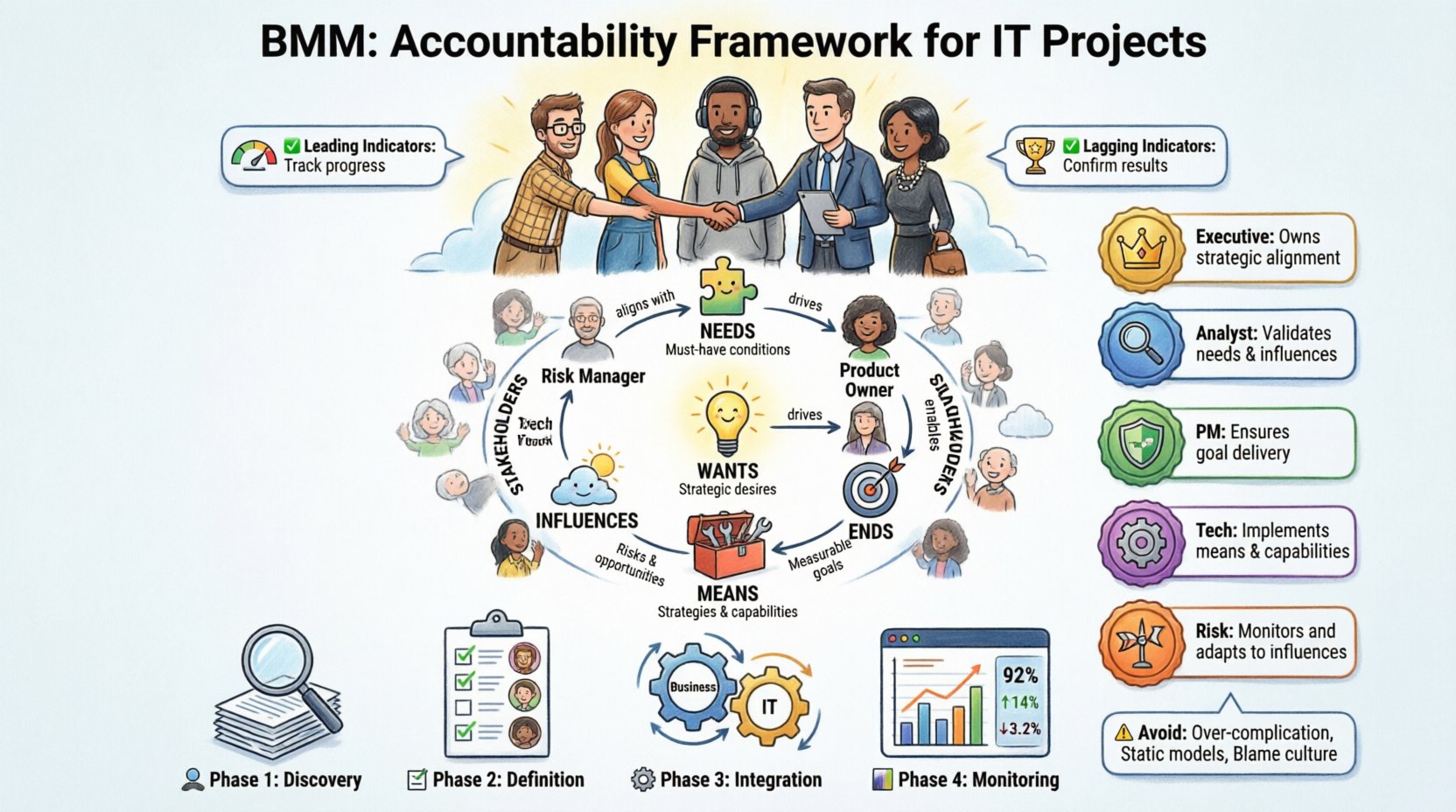
Understanding the Business Motivation Model 🧠
The Business Motivation Model is a standardized framework used to describe the business requirements and motivations that drive an organization. It was developed to bridge the gap between business strategy and IT implementation. Rather than focusing solely on processes or data, BMM focuses on why actions are taken.
At its core, the model distinguishes between the ends (goals) and the means (how to achieve them). This distinction is crucial for accountability. If a project team knows the end goal but is unclear on the means, or vice versa, errors occur.
Core Elements of BMM
- Wants: Desirable outcomes or changes the organization seeks. These are the high-level desires.
- Needs: Conditions that must be met to realize the Wants. These are functional or operational requirements.
- Ends: Specific, measurable objectives derived from Needs. These are the targets.
- Means: The strategies, tactics, and capabilities used to achieve the Ends. This is the execution layer.
- Influences: Factors that affect the ability to achieve Ends, such as risks or opportunities.
- Stakeholders: The individuals or groups with an interest in the outcome.
By mapping these elements, IT leaders can ensure that every line of code, every sprint, and every deployment traces back to a specific organizational Want or Need.
The Accountability Gap in IT Projects 📉
Accountability in IT often suffers from ambiguity. A common scenario involves a business unit requesting a feature without defining the business value. The IT team builds the feature, but when the value isn’t realized, the project is deemed a failure. This happens because the accountability for value was never assigned.
Traditional project management focuses on scope, time, and cost. While important, these metrics do not guarantee business motivation is met. BMM shifts the focus to value realization.
Common Symptoms of Weak Accountability
- Shifting Goals: Requirements change frequently without understanding the underlying impact on strategic goals.
- Blame Shifting: When delays occur, business blames IT, and IT blames business for unclear requirements.
- Lack of Ownership: No single person is responsible for the success of a specific business outcome.
- Disconnected Metrics: IT success is measured by uptime or delivery speed, not by business revenue or efficiency gains.
Using the Business Motivation Model helps resolve these symptoms by forcing a conversation about why the project exists before discussing how it will be built.
Mapping BMM to Accountability 🗺️
To establish accountability, one must link the abstract motivations of the business to the concrete tasks of the IT team. This mapping creates a chain of responsibility that is transparent to all stakeholders.
Defining Roles through BMM Elements
Each element of the BMM corresponds to a specific type of accountability. The following table outlines how these elements translate into project roles and responsibilities.
| BMM Element | Accountability Focus | Typical Role |
|---|---|---|
| Wants | Strategic Value Definition | Executive Sponsor / Business Owner |
| Needs | Requirement Clarity | Product Owner / Business Analyst |
| Ends | Goal Achievement | Project Manager / Delivery Lead |
| Means | Execution & Quality | Team Lead / Architect |
| Influences | Risk Management | Risk Manager / Compliance Officer |
This matrix ensures that for every strategic intent, there is a designated owner. It prevents the situation where a goal is set but no one is tasked with monitoring its realization.
Strategic Intent and End Goals 🎯
Strategic intent is the starting point for accountability. In IT projects, this often gets lost in technical jargon. The Business Motivation Model requires that every project begins with a clear statement of the Ends.
An End must be specific and measurable. For example, instead of saying “Improve customer experience,” an End should be “Reduce customer support ticket resolution time by 20% within six months.”
Steps to Define Ends
- Identify the Business Pain Point: What is the current inefficiency or gap?
- Quantify the Desired State: How will success look numerically?
- Assign Ownership: Who is responsible for ensuring this number moves?
- Validate Feasibility: Do the current Means support this End?
When Ends are defined clearly, the IT team gains a target. The accountability is no longer just about “building software”; it is about “achieving a reduction in ticket resolution time.” This distinction empowers the team to suggest technical solutions that directly impact the metric, rather than just following a specification.
Stakeholder Roles and Influence 👥
Stakeholders in IT projects are not just passive observers. In the BMM framework, they are active participants who influence the project’s success. Understanding the difference between a Stakeholder and an Influencer is vital for accountability.
Stakeholders have a vested interest in the outcome. They are the ones who feel the impact of the Ends. Influencers have the power to affect the Means or the Ends, but may not bear the direct consequences of the outcome.
Managing Influences
Accountability requires managing influences effectively. Some influences are positive (opportunities), while others are negative (risks). A robust BMM implementation tracks these actively.
- Identify Influencers: List all parties who can change the project scope or timeline.
- Assess Impact: Determine how their actions affect the Ends.
- Define Control: Establish which influencers have decision-making power and which only provide input.
- Document Relationships: Create a visual map showing who influences what.
By documenting these relationships, organizations prevent scope creep from unauthorized sources. If a stakeholder requests a change, the team can trace that request back to the BMM structure to see if it aligns with the original Ends. If it does not, the request can be evaluated based on its cost to the primary goals.
Tactics and Capabilities in Execution 🛠️
Once Ends are set and Influences are managed, the focus shifts to Means. Means are divided into Tactics (high-level plans) and Capabilities (the specific abilities required to execute).
Accountability in this phase belongs to the execution teams. However, they must understand how their Tactics link to the Ends. A tactic that looks good in isolation might fail if it does not support the overarching Need.
Aligning Capabilities
Capabilities represent the skills, resources, and technology available. If a project has ambitious Ends but lacks the necessary Capabilities, accountability must address this gap. This might mean investing in training, hiring, or acquiring new tools.
It is the responsibility of the project leadership to ensure that the Means are sufficient for the Ends. If the Capabilities are lacking, the Ends must be adjusted, or the Capabilities must be acquired. Ignoring this leads to failure.
Practical Application Example
Consider a migration project. The End is to reduce infrastructure costs by 30%. The Need is to move legacy systems to the cloud. The Tactic is a phased migration strategy. The Capability is the DevOps team’s expertise in cloud architecture.
If the DevOps team lacks cloud expertise, the Capability is insufficient. The accountability here lies with the leadership to either train the team or hire external consultants before the project begins. This prevents the “blame game” later when costs do not drop.
Implementation Steps for Accountability 🚀
Integrating the Business Motivation Model into existing IT workflows requires a structured approach. It is not something that happens overnight, but rather a process of gradual alignment.
Phase 1: Discovery and Mapping
- Conduct workshops with business leaders to identify Wants and Needs.
- Document current project goals and compare them against identified Wants.
- Identify gaps where projects exist without clear strategic alignment.
Phase 2: Definition and Assignment
- Formalize the Ends for all active projects.
- Assign specific owners to each End and Means element.
- Create a shared vocabulary for Wants, Needs, and Ends across the organization.
Phase 3: Integration into Workflow
- Include BMM elements in project charters.
- Update status reports to show progress against Ends, not just tasks.
- Review Influences regularly during sprint or phase reviews.
Phase 4: Continuous Monitoring
- Establish a feedback loop where business outcomes are measured post-deployment.
- Adjust Ends if the business environment changes significantly.
- Ensure accountability owners remain updated on their specific domains.
Common Pitfalls and Risks ⚠️
While the Business Motivation Model offers significant benefits, implementation is not without challenges. Organizations must be aware of common pitfalls to avoid undermining the accountability framework.
Pitfall 1: Over-Complication
BMM can become overly complex if every small detail is mapped. It is important to focus on high-level strategic connections first. If the model becomes too burdensome, stakeholders will stop using it.
Pitfall 2: Static Models
Business environments change. A BMM model created at the start of a project may become obsolete if the market shifts. Accountability requires the flexibility to update the model as new information arises.
Pitfall 3: Ignoring the Human Element
Accountability is not just about processes; it is about people. If team members feel the BMM is being used to punish them rather than clarify goals, they will resist it. The focus must remain on enabling success, not assigning blame.
Measurement and Monitoring 📊
To ensure accountability is maintained, metrics must be tied to the BMM structure. Traditional IT metrics like “velocity” or “bug count” are insufficient on their own.
Leading vs. Lagging Indicators
- Lagging Indicators: Measure the End after it has occurred (e.g., total revenue generated). These confirm accountability but do not guide action.
- Leading Indicators: Measure progress toward the End (e.g., user adoption rate). These allow for course correction.
Effective accountability uses a mix of both. The BMM helps identify which indicators matter most. If the End is “Reduce Support Tickets,” the leading indicator might be “Knowledge Base Article Views,” while the lagging indicator is “Ticket Volume.”
Review Cadence
Accountability requires regular review. Monthly or quarterly business reviews should focus on the alignment between Means and Ends. This ensures that the project remains on track to deliver the intended value.
During these reviews, ask:
- Has the Want changed?
- Do the current Ends still reflect the Want?
- Are the Means still effective given the current Influences?
Conclusion on Accountability and BMM 📝
Establishing accountability in IT projects is not about creating a system of surveillance. It is about creating a system of clarity. The Business Motivation Model provides the structure needed to connect business desires with technical execution. By defining Wants, Needs, Ends, and Means, organizations can ensure that every team member understands their role in the larger picture.
When accountability is rooted in motivation, teams are more engaged. They understand the “why” behind their work. This leads to better decision-making, fewer reworks, and higher value delivery. The journey to full alignment takes time and discipline, but the result is a more resilient and responsive IT organization.
Start by mapping your current projects against the BMM elements. Identify where the links are weak. Strengthen those links, and you will build a foundation for sustainable project success.