


In modern enterprise strategy, the disconnect between technology investment and financial outcomes remains a persistent challenge. Organizations often allocate substantial budgets toward digital transformation, infrastructure upgrades, and software implementation without a clear line of sight to revenue generation. This opacity creates friction between IT departments and business leadership. To bridge this gap, a structured framework is required. The Business Motivation Model (BMM) offers a standardized way to articulate the relationship between organizational desires and the means to achieve them. By applying this model, leaders can map specific technology capabilities directly to revenue drivers. This guide explores how to utilize BMM to demonstrate tangible technology impact on revenue, ensuring every line of code and every server contributes to the bottom line. 💼
🧩 Understanding the Business Motivation Model (BMM) 🧠
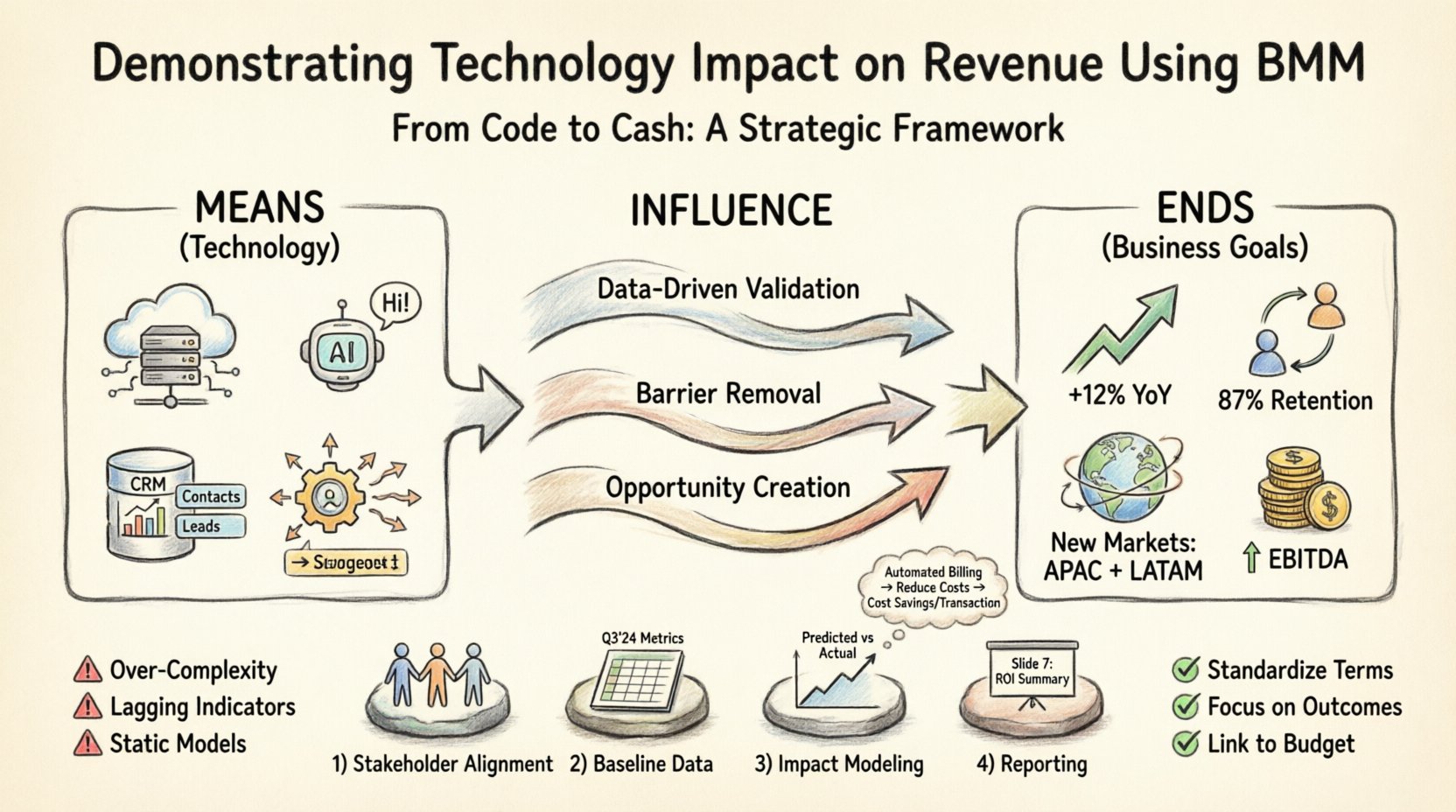
The Business Motivation Model is not merely a diagramming tool; it is a conceptual framework designed to describe business motivation and strategy. It provides a common language for stakeholders to discuss how an organization intends to achieve its goals. At its core, BMM distinguishes between what an organization wants to achieve (the Ends) and how it intends to achieve those outcomes (the Means). This distinction is critical when evaluating technology.
- Ends: These represent the objectives, goals, and desires of the enterprise. They answer the question, “What do we want?”
- Means: These represent the capabilities, resources, and activities required to reach the Ends. They answer the question, “How do we get there?”
- Influence: This is the relationship that connects Means to Ends. Technology typically falls under the category of Means that positively influence the achievement of Revenue Goals.
When technology is viewed through the lens of BMM, it shifts from being a cost center to a strategic enabler. Instead of asking “How much does this server cost?”, the question becomes “How does this server capability influence our customer acquisition goal?” This shift in perspective is fundamental to demonstrating revenue impact. 🔄
🔗 Mapping Technology to Business Goals 🎯
To demonstrate impact, one must establish a traceable chain of influence from technology assets to financial results. This process involves decomposing high-level revenue goals into actionable business objectives, and then identifying the technology means required to support them. The following steps outline the logical flow.
1. Define the Revenue Goal
Revenue is often a lagging indicator. To measure technology impact effectively, goals must be broken down. A generic goal like “Increase Revenue by 10%” is difficult to influence directly with technology. Instead, define intermediate objectives.
- Objective A: Reduce customer churn rate by 5%.
- Objective B: Increase average order value by 15%.
- Objective C: Expand into a new geographic market.
These objectives serve as the bridge between raw technology capabilities and the final financial statement.
2. Identify Technology Capabilities (Means)
Once objectives are clear, identify the specific technology capabilities required. In BMM terms, these are the “Means” that enable the “Ends”. For example, if the objective is to reduce churn, the capability might be “Real-time Customer Support Analytics”. If the objective is to increase order value, the capability might be “Personalized Recommendation Engine”.
3. Establish the Influence Relationship
The final step in mapping is to validate the influence. Does the technology actually drive the objective? This requires data. If the recommendation engine is deployed, does it correlate with higher basket sizes? The BMM framework allows for the documentation of this influence strength. It is not enough to assume; the model requires explicit linkage.
| Business Goal (End) | Business Objective (End) | Technology Capability (Mean) | Revenue Impact Metric |
|---|---|---|---|
| Maximize Profitability | Reduce Operational Costs | Automated Billing System | Cost Savings per Transaction |
| Expand Market Share | Increase Lead Conversion | CRM Integration Layer | Conversion Rate % |
| Enhance Customer Experience | Reduce Support Ticket Volume | AI Chatbot Service | Ticket Volume Reduction |
| Increase Revenue Streams | Launch New Product Feature | Cloud Infrastructure | Feature Adoption Rate |
📉 Quantifying the Impact: From Capability to Cash 💰
The most difficult aspect of this analysis is quantification. Technology often creates value that is indirect. For example, improved stability (a technical goal) leads to higher customer trust (a business goal), which leads to retention (a revenue goal). To demonstrate this in BMM, one must assign measurable indicators to each step of the chain.
Direct Revenue Contributions
Some technologies have a direct line to revenue. E-commerce platforms, payment gateways, and subscription management systems are obvious examples. The revenue generated is easily attributed to the technology stack. However, even here, BMM helps clarify dependencies. If the payment gateway slows down, does the goal of “Processing 1000 transactions per hour” fail? Yes. The model helps identify the critical path.
Indirect Revenue Contributions
More often, technology supports revenue through efficiency or risk reduction. Efficiency gains free up capital that can be reinvested. Risk reduction prevents revenue loss. For instance, cybersecurity measures do not generate new sales directly, but they prevent data breaches that could result in massive fines and reputational damage (which destroys revenue potential). BMM captures this as a “Barrier” removal.
- Barrier Removal: Technology removes obstacles preventing revenue. Example: Legacy systems blocking new product launches.
- Opportunity Creation: Technology enables new revenue streams. Example: Mobile app enabling micro-transactions.
🛠 Implementing the Model in Practice 🛠
Applying the Business Motivation Model to technology assessment requires discipline. It is not a one-time exercise but an ongoing governance process. The following workflow ensures consistency.
Step 1: Stakeholder Alignment
Begin by gathering input from both business units and IT leadership. Business units define the “Ends” (Revenue targets, Market goals). IT defines the “Means” (Infrastructure, Applications, Data). A workshop setting is often effective to map these relationships visually.
Step 2: Data Collection and Baseline
Before projecting impact, establish a baseline. What is the current revenue performance? What is the current technology performance? Without historical data, measuring change is impossible. Collect metrics on system uptime, latency, user adoption, and support ticket resolution times.
Step 3: Impact Modeling
Use the collected data to model scenarios. If technology capability X improves by 10%, how does that affect Objective Y? This is where the “Influence” relationship is tested. It is acceptable to use estimated coefficients initially, provided they are refined over time as more data becomes available.
Step 4: Reporting and Governance
Integrate these findings into regular reporting cycles. Do not hide the model in a technical document. Present the influence maps to the executive team. Show how specific technology investments are tied to specific financial outcomes. This transparency builds trust and justifies future budget requests.
⚠️ Common Pitfalls and Challenges ⚠️
While the framework is robust, organizations often stumble during implementation. Being aware of these common issues helps in navigating the process successfully.
1. Over-Complexity
One mistake is creating a model that is too detailed. If every single server rack is mapped to a revenue goal, the model becomes unmanageable. Focus on high-level capabilities that have significant influence. Aggregate lower-level technical details into broader capability nodes.
2. Ignoring Lagging Indicators
Revenue is a lagging indicator. Technology changes happen in the present, but financial results appear in the next quarter. Do not expect immediate revenue spikes from every technology change. The model should account for time lags between capability deployment and financial realization.
3. Blaming the Tool for Process Failure
Sometimes, technology is the wrong solution to a business problem. If a revenue goal is not met, it is tempting to blame the technology. The BMM helps diagnose this. If the “Means” (Technology) is adequate but the “End” is not achieved, the issue may lie in the “Motivation” (Sales strategy, Pricing) rather than the infrastructure.
4. Static Models
A BMM model is not a static diagram. Business goals change, and technology evolves. A model built today may be obsolete in six months. Establish a review cadence. Update the influence relationships as new products launch or markets shift.
📈 Best Practices for Long-Term Success 📈
To sustain the value of this approach, organizations should adopt specific best practices.
- Standardize Terminology: Ensure that everyone uses the same definitions for “Goal”, “Objective”, and “Capability”. Ambiguity leads to misalignment.
- Focus on Outcomes: Do not measure technology usage (e.g., “number of servers”). Measure business outcomes (e.g., “customer response time”).
- Link to Budgeting: Tie technology budget approvals to the BMM. If a project does not map to a defined business goal, it should not receive funding. This enforces discipline.
- Visual Communication: Use diagrams to communicate the model. A complex text document is less effective than a visual map showing the flow from Tech to Revenue.
- Cross-Functional Teams: Ensure that both IT and Finance are involved in the modeling process. Finance understands the revenue metrics; IT understands the technical constraints. Both are needed for a complete picture.
🔍 Deep Dive: The Role of Data in BMM 📊
Data is the fuel that powers the Business Motivation Model. Without accurate data, the influence relationships are merely assumptions. In the context of technology and revenue, data integrity is paramount.
Consider a scenario where a new marketing automation tool is deployed. The goal is to increase lead volume. The technology capability is “Automated Email Sequencing”. To validate this in BMM:
- Track Input: Measure the number of emails sent.
- Track Output: Measure the number of leads generated.
- Track Revenue: Measure the conversion of leads to sales.
- Correlate: Determine the statistical correlation between the automation tool usage and the sales figures.
If the data shows no correlation, the “Influence” relationship in the model is weak. This insight allows the organization to pivot. Perhaps the tool is fine, but the content strategy is weak. Or perhaps the tool is the wrong capability for the goal. BMM provides the structure to ask these questions without assigning blame prematurely.
🚀 Scaling the Approach Across the Enterprise 🏢
Once the model is proven in one department, it can be scaled. However, scaling introduces complexity. Different departments may have different definitions of “Revenue”. Marketing might focus on new customer acquisition, while Sales focuses on account expansion. The BMM framework must be flexible enough to accommodate these variations while maintaining a unified corporate view.
Consider a centralized repository for the model. This repository should store all goals, objectives, and means. It should allow for drilling down from the corporate level to the departmental level. This hierarchy ensures that local technology decisions contribute to the global strategy. If a local team invests in a tool that does not align with the corporate goal, the model flags the discrepancy.
🌟 Final Thoughts on Strategic Alignment 🌟
Demonstrating technology impact on revenue is not about proving that IT is valuable. It is about ensuring that the organization is aligned toward a common purpose. The Business Motivation Model provides the vocabulary and the structure to facilitate this alignment. By treating technology as a strategic means rather than a utility, leaders can make better investment decisions.
The journey from technical specification to financial result is long. It requires patience, data, and a willingness to challenge assumptions. When done correctly, the BMM transforms the conversation from “What did we spend?” to “What did we achieve?”. This shift empowers technology leaders to speak the language of business and ensures that every digital initiative contributes to the growth and sustainability of the enterprise. 🤝
By adhering to this framework, organizations can move beyond intuition and guesswork. They can build a culture of accountability where technology investments are scrutinized through the lens of business value. This disciplined approach is the foundation of modern digital strategy. It ensures that technology serves the business, rather than the business serving the technology.