


Organizations often face a persistent challenge: IT spending does not always reflect strategic priorities. Departments request funds for systems or infrastructure based on immediate technical needs, yet these requests may not directly contribute to the broader mission of the company. This disconnect creates friction between finance teams and technology leaders. To resolve this, a structured approach is required to translate technical expenditures into business value.
The Business Motivation Model (BMM) offers a robust framework for this alignment. It provides a standardized way to document the drivers behind decisions, ensuring that every dollar spent in the IT department serves a defined purpose. By using BMM, IT leaders can move from defending costs to demonstrating value. This guide explores how to leverage this model for budget justification and strategic alignment.
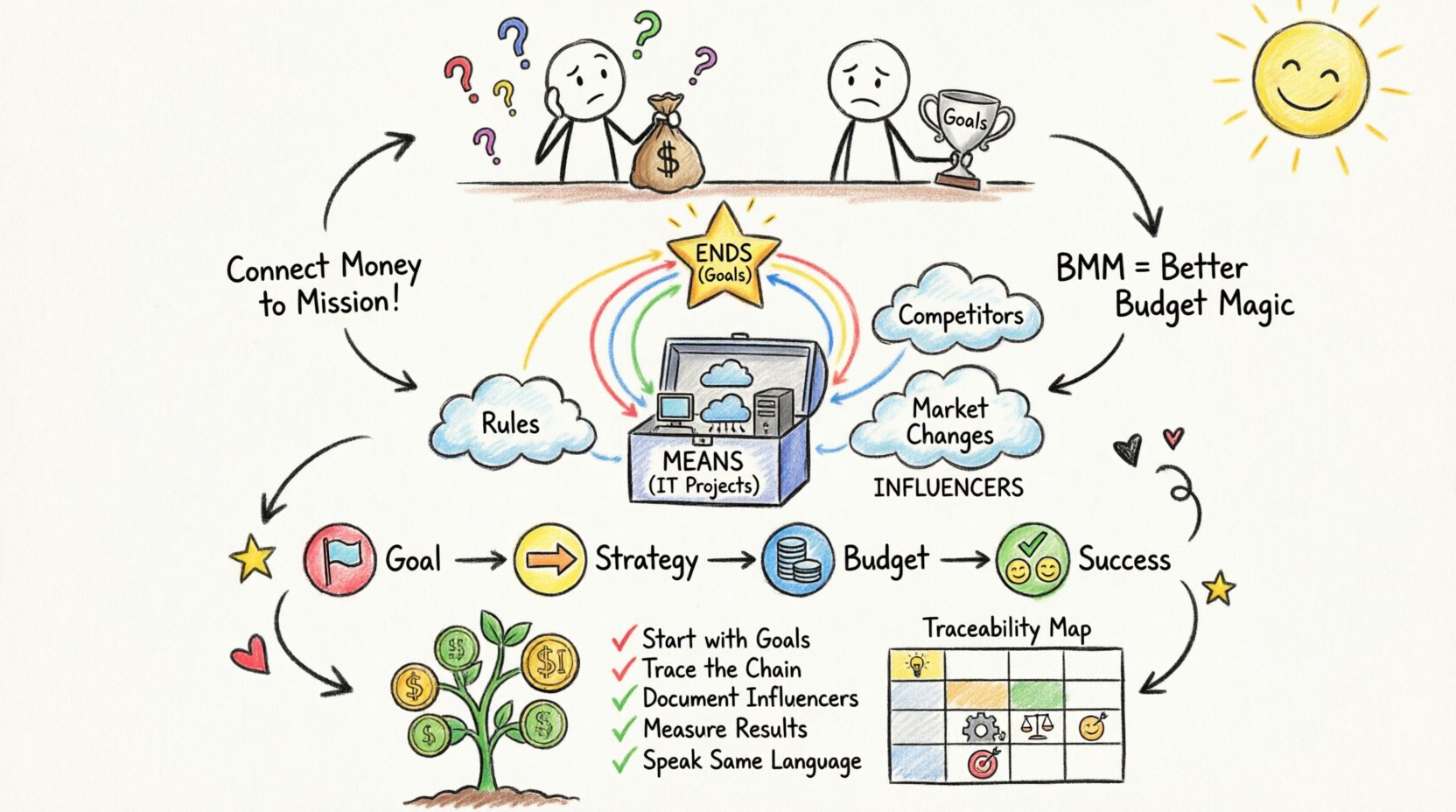
Understanding the Disconnect in IT Budgeting 💰
Traditional budgeting processes often rely on historical data. Teams ask, “What did we spend last year, plus 5%?” This method fails to account for shifting business landscapes. New market demands, regulatory changes, or competitive threats may render previous spending obsolete.
When IT requests are submitted without context, finance leaders view them as overhead. They see costs, not investments. This perception leads to cuts in areas that might actually drive growth. The problem is not the lack of funds, but the lack of clear linkage between the money requested and the outcomes expected.
Consider the following common scenarios:
- Infrastructure Upgrade: Requested because servers are old. Business Link: Unstated. Correct Link: Reduces downtime risk, supporting customer service continuity.
- Software License: Requested for a new analytics tool. Business Link: Unstated. Correct Link: Enables data-driven decision-making to improve sales conversion.
- Security Patch: Requested for compliance. Business Link: Unstated. Correct Link: Protects brand reputation and avoids regulatory fines.
The Business Motivation Model provides the vocabulary to articulate these links clearly. It structures the relationship between Ends (what we want) and Means (what we do to get there).
Core Concepts of the Business Motivation Model 🏗️
BMM is not a software tool; it is a conceptual framework. It helps organizations describe why they do what they do. The model breaks down organizational activity into specific, interrelated elements. Understanding these elements is crucial for budget alignment.
1. Ends: The Desired Outcomes
Ends represent the goals, needs, and objectives an organization seeks to achieve. In the context of budgeting, these are the targets that justify the expenditure.
- Business Goal: A broad target, such as increasing market share by 10%.
- Business Need: A specific requirement, such as reducing customer wait times.
- Business Objective: A measurable step toward a goal, such as implementing a chatbot system.
When preparing a budget request, you must start with the End. What specific business problem are you solving? If you cannot identify the End, the request lacks strategic weight.
2. Means: The Actions and Resources
Means are the strategies, tactics, and resources used to achieve the Ends. In IT budgeting, the Means are the projects, infrastructure, and personnel costs.
- Strategy: A high-level plan, such as “Cloud Migration Strategy.”
- Tactic: A specific action, such as “Migrate Database to AWS.”
- Resource: The actual funding or hardware required.
The budget line item is a Resource. It must be connected upward through Tactics and Strategies to a Goal.
3. Influencers: The External Factors
Influencers impact the ability to achieve Ends or execute Means. These include policies, rules, environmental factors, and competitors.
- Policy: Internal rules, such as “All data must be encrypted.”
- Rule: Legal requirements, such as GDPR compliance.
- Environment: Market conditions, such as a recession or a new competitor.
Ignoring Influencers in budget planning is risky. A project might be viable, but a new regulation could make it obsolete or mandatory.
Mapping Budget Requests to Strategic Goals 📊
Applying the BMM to budgeting involves creating a traceability chain. This chain connects a specific dollar amount to a high-level business vision. The process requires discipline and documentation.
Step 1: Define the Strategic Context
Before writing a single budget line item, review the organizational strategy. What are the top three business goals for the fiscal year? Ensure every major IT initiative supports at least one of these goals.
Example:
- Goal: Improve Customer Retention.
- Need: Faster response to customer inquiries.
- Strategy: Implement automated support tools.
Step 2: Identify the Means
Translate the strategy into actionable IT projects. These become the budget requests.
- Tactic: Purchase and configure Customer Relationship Management (CRM) software.
- Resource: $50,000 for licensing and implementation services.
Step 3: Document the Influencers
Identify what drives this need. Is it a compliance rule? A market trend? Documenting this helps stakeholders understand the urgency.
- Influencer: Competitors offering 24/7 support.
- Influencer: Internal policy requiring ticket resolution within 2 hours.
Step 4: Create the Traceability Matrix
Visualize the connection. A simple table can effectively map the budget request to the goal.
| Budget Item | Tactic / Strategy | Business Need | Strategic Goal | Influencer |
|---|---|---|---|---|
| CRM License | Automate Support | Reduce Response Time | Improve Retention | Competitor Action |
| Server Upgrade | Ensure Uptime | Prevent Downtime | Operational Excellence | SLA Agreement |
| Security Audit | Risk Mitigation | Protect Data | Compliance & Trust | Regulatory Change |
This table transforms a cost into a strategic investment. Finance teams can see exactly how the money contributes to the organization’s success.
Justifying IT Investments with Evidence 🔍
Once the alignment is established, the next challenge is proving the value. Budget approvals often hinge on Return on Investment (ROI) or Return on Objectives (ROO). BMM supports both.
Quantitative Metrics
For budget items with clear financial outcomes, use quantitative data.
- Cost Savings: If automating a process saves 10 hours per week, calculate the annual labor savings.
- Revenue Generation: If a new tool helps sales close deals faster, estimate the additional revenue.
- Risk Reduction: Assign a monetary value to the risk of not acting. For example, the cost of a data breach versus the cost of prevention.
Qualitative Metrics
Not all goals are financial. Some are about reputation or employee satisfaction. BMM allows these to be documented as valid Ends.
- Employee Morale: New collaboration tools may improve team cohesion.
- Brand Perception: A modern website improves customer trust.
- Agility: Better infrastructure allows the company to pivot faster.
When presenting to leadership, combine these metrics. Show the hard numbers where possible, but explain the strategic importance of the qualitative factors.
Handling Risks and Policies in Planning 🛡️
Budgeting is not just about planning success; it is about managing failure risks. The BMM framework explicitly includes Influencers that can block progress. Addressing these proactively strengthens the budget case.
Identifying Constraints
Some budget requests are driven by constraints that must be met to operate legally or safely.
- Compliance: Financial regulations often require specific data retention capabilities.
- Security Standards: Industry standards (like ISO 27001) dictate security spending.
- Legacy Debt: Maintaining old systems might be more expensive than replacing them, but the risk of replacement is higher.
Scenario Planning
Use the model to test budget scenarios. What happens if Influencers change?
- Scenario A: Revenue grows 20%. Does the IT infrastructure scale automatically?
- Scenario B: A new competitor enters the market. Do we have the budget to innovate quickly?
- Scenario C: A major security incident occurs. Is our contingency fund sufficient?
By documenting these scenarios, you show leadership that you have thought beyond the immediate line items. This builds confidence in the budget request.
Communication and Governance with Stakeholders 🗣️
Aligning IT budgets requires collaboration across the organization. The BMM provides a common language for IT and Business leaders. This reduces misunderstandings and friction.
Creating a Shared Vocabulary
When IT speaks of “infrastructure” and Business speaks of “value,” they are often talking past each other. BMM bridges this gap.
- IT View: We need to upgrade the network.
- Business View: We need faster transaction speeds to close sales.
- BMM View: The network upgrade is the Means to achieve the Goal of faster sales.
Using this shared language makes budget meetings more productive. It shifts the conversation from “Can we afford this?” to “Does this help us win?”
Establishing Governance
Once the model is in place, governance ensures it is used consistently.
- Review Cadence: Review budget alignments quarterly, not just annually.
- Change Management: If business goals change, the budget must change. The BMM makes this link visible.
- Accountability: Assign owners to specific Ends and Means. Who is responsible for achieving the goal linked to this budget?
Measuring Outcomes and Feedback Loops 📈
The budget cycle does not end when funds are allocated. It continues through the execution phase. BMM supports a feedback loop to measure success.
Tracking Performance
After implementation, compare actual results against the planned Ends.
- Goal Met? Did the initiative improve retention?
- Cost Control? Did the project stay within the budget?
- Timeframe? Was the goal achieved within the fiscal year?
Adjusting the Model
If the results do not match expectations, the model helps identify why.
- Was the Means effective? Perhaps the technology was sound, but the adoption was low.
- Was the Goal realistic? Perhaps the target was too ambitious for the investment.
- Did Influencers change? Did a new competitor invalidate the strategy?
This analysis informs the next budget cycle. It ensures that past spending teaches future planning.
Common Implementation Challenges ⚠️
Adopting this approach requires effort. Organizations often face hurdles when trying to integrate BMM into their budgeting processes.
Challenge 1: Complexity
BMM can seem complex with many diagrams and definitions. Start simple. Do not map every single expense immediately. Focus on the major initiatives first.
Challenge 2: Resistance to Change
Some stakeholders prefer the old way of budgeting because it is familiar. Show them the benefits. Demonstrate how BMM reduces the back-and-forth during approval meetings.
Challenge 3: Data Availability
You need accurate data on costs and outcomes. If historical data is missing, start collecting it now. Use the current cycle as a pilot to establish baselines.
Sustaining the Model for Long-Term Value 🌱
The true value of the Business Motivation Model is not in a single budget cycle, but in the long-term cultural shift it creates. It turns IT from a cost center into a strategic partner.
- Continuous Improvement: Regularly refine the definitions of Goals and Means.
- Talent Development: Train IT staff on strategic thinking, not just technical skills.
- Transparency: Make the alignment visible to all stakeholders. Transparency builds trust.
When IT leaders consistently demonstrate how their spending drives business success, the relationship with Finance transforms. Budget requests are viewed as strategic enablers rather than administrative burdens.
Summary of Key Takeaways ✅
Aligning IT budgets with business goals requires a structured framework. The Business Motivation Model provides this structure by defining Ends, Means, and Influencers. By mapping budget requests to these elements, organizations can ensure every dollar supports the mission.
Key actions for success include:
- Define Ends First: Start with business goals, not technical specs.
- Trace the Chain: Connect resources to tactics, strategies, and goals.
- Document Influencers: Acknowledge external factors that impact success.
- Measure Outcomes: Verify that the investment delivered the expected value.
- Communicate Clearly: Use the model to speak the same language as business leaders.
This approach does not rely on hype or specific software tools. It relies on clear thinking and disciplined planning. In an environment where resources are limited, this discipline is the difference between survival and growth. By adopting the Business Motivation Model, IT organizations secure their place at the table where strategic decisions are made.
The path forward is clear. Map the money to the mission. Build the budget on the foundation of value. Align the technology with the strategy.