


In the complex landscape of modern enterprise, the technology department often operates as a critical engine rather than a support function. However, without a clearly defined purpose, even the most sophisticated infrastructure can drift away from organizational goals. This guide explores how to define clear mission statements for technology departments using the Business Motivation Model (BMM). By applying this structured framework, leaders can ensure alignment between technical capabilities and business value.
Understanding the Strategic Gap 📉
Technology teams frequently face challenges in articulating their value. A common issue is the disconnect between what engineering builds and what the business actually needs. This misalignment often stems from vague directives. A mission statement serves as the foundational anchor. It clarifies the why behind every project, deployment, and investment.
When a technology mission is undefined, resources are wasted on low-priority initiatives. When it is well-defined, every line of code and every server provisioned contributes to a broader strategic objective. The Business Motivation Model provides the vocabulary and structure to bridge this gap effectively.
What is the Business Motivation Model? 🏗️
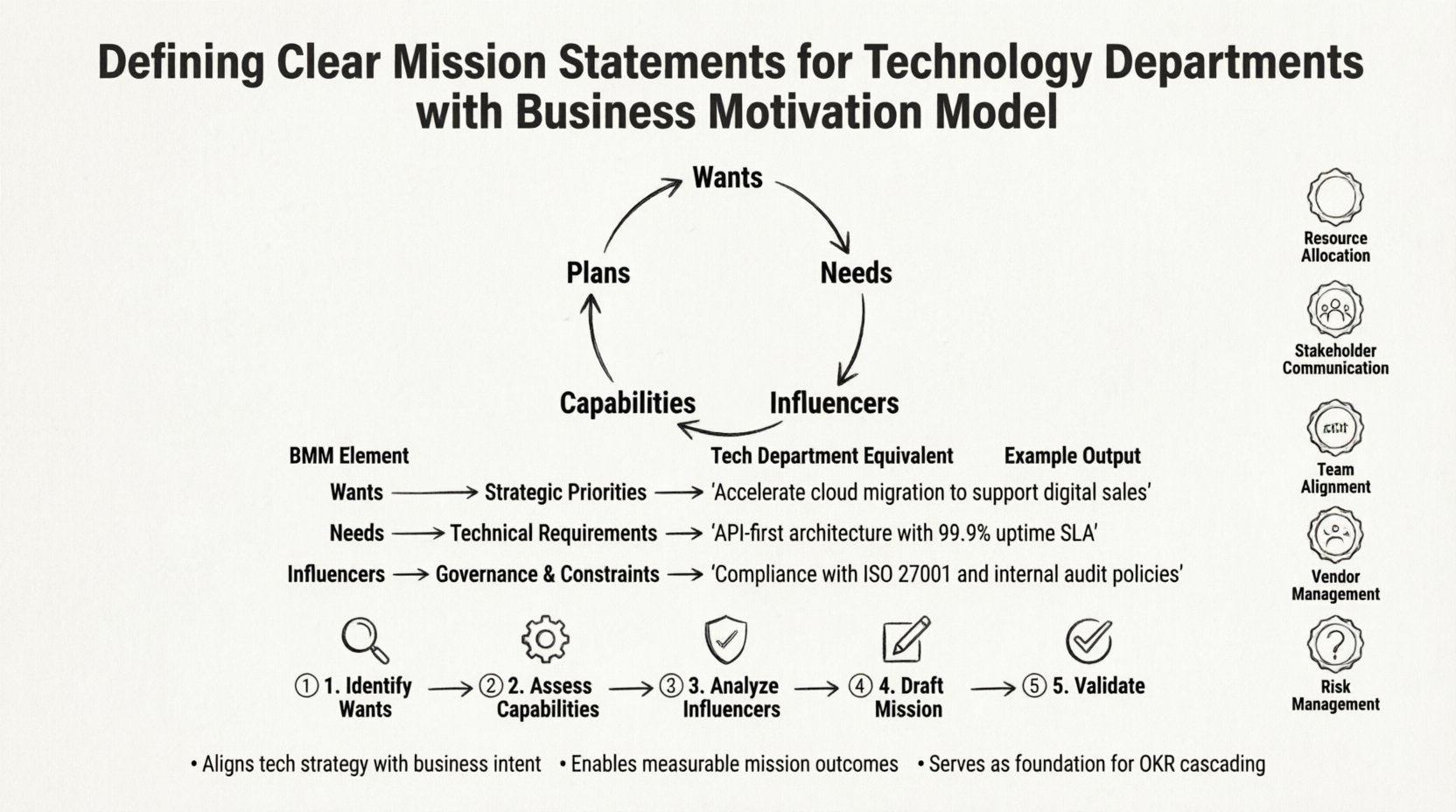
The Business Motivation Model is a standard framework used in enterprise architecture to describe how an organization functions. It focuses on the relationships between people, goals, and capabilities. Instead of viewing an organization as a static hierarchy, BMM treats it as a dynamic system of motivations and actions.
For a technology department, adopting this model means moving beyond technical jargon to speak the language of business impact. The core components of BMM include:
- Wants: What the organization desires to achieve.
- Needs: Constraints or requirements that must be met.
- Influencers: External and internal factors that impact decisions.
- Capabilities: The skills, resources, and technologies available to act.
- Plans: The strategies and roadmaps designed to bridge the gap between Wants and Needs.
Applying these concepts to a technology mission ensures that the department is not just maintaining systems, but actively driving the organization forward.
Why Technology Departments Need a Defined Mission 🚀
A mission statement is more than a marketing slogan. It is a strategic tool for governance and decision-making. Here is why defining it is critical:
- Resource Allocation: When budgets are tight, a clear mission helps prioritize projects that align with core objectives.
- Stakeholder Communication: It provides a clear narrative for non-technical executives regarding IT investments.
- Team Alignment: Engineers and architects work better when they understand the business context of their tasks.
- Vendor Management: It sets boundaries for what third-party solutions are acceptable based on strategic fit.
- Risk Management: A defined mission highlights which risks are acceptable and which are not based on organizational priorities.
Without this clarity, technology departments risk becoming cost centers that consume resources without delivering measurable value. With it, they become strategic partners.
Mapping BMM Elements to Technology Mission Components 📊
To construct a robust mission statement, one must translate abstract BMM concepts into concrete technology directives. The following table illustrates how specific BMM elements map to technology department artifacts.
| BMM Element | Technology Department Equivalent | Example Output |
|---|---|---|
| Wants | Business Value Proposition | “Enable real-time data processing for customer insights.” |
| Needs | Compliance & Security Requirements | “Maintain GDPR compliance and zero-downtime SLAs.” |
| Influencers | Market Trends & Tech Debt | “Adopt cloud-native architectures to reduce latency.” |
| Capabilities | Infrastructure & Talent | “Leverage existing cloud stack and senior engineering talent.” |
| Plans | IT Roadmap & Architecture | “Execute a 3-year migration to microservices.” |
Step-by-Step Guide to Defining the Mission 🛠️
Creating a mission statement using BMM requires a structured approach. It is not a one-off task but an iterative process involving key stakeholders. Follow these steps to develop a statement that holds weight and drives action.
1. Identify Organizational Wants 🧭
Start by understanding the broader business goals. What is the company trying to achieve in the next 3 to 5 years? Is it market expansion? Cost reduction? Innovation? The technology mission must directly support these high-level desires.
- Interview C-suite executives to understand their priorities.
- Review annual strategic plans for recurring themes.
- Ask: “If technology succeeds, what does the business look like?”
2. Assess Current Capabilities 🛠️
Be honest about what the technology department can actually do. Overpromising leads to failure. Assess the current state of infrastructure, software, and human capital.
- Conduct an inventory of existing systems.
- Evaluate skill sets within the current team.
- Identify gaps between current state and desired state.
3. Analyze Influencers and Needs ⚖️
Identify the constraints. These are the factors that limit what can be done. In BMM terms, these are the Needs and Influencers.
- External Influencers: Regulatory changes, competitor actions, economic shifts.
- Internal Needs: Budget caps, security policies, legacy system dependencies.
- Technical Debt: Acknowledge the weight of past decisions on future possibilities.
4. Draft the Mission Statement ✍️
Combine the Wants, Capabilities, and Constraints into a concise declaration. It should be specific enough to guide decisions but broad enough to allow for flexibility. Avoid vague buzzwords.
Weak Example: “We build great software.”
Strong Example: “We deliver secure, scalable platforms that accelerate product innovation while maintaining operational stability.”
5. Validate with Stakeholders 🔍
Once drafted, present the mission to business leaders and technical staff. Ensure it resonates with both groups. If business leaders do not recognize their goals in the statement, or if engineers do not see how it guides their daily work, revisions are necessary.
- Hold workshops to discuss the draft.
- Refine based on feedback.
- Get formal sign-off from leadership.
Integrating the Mission into Daily Operations 🔄
Once the mission is defined, it must be integrated into the workflow. A document that sits in a shared drive is useless. The mission must influence decision-making at all levels.
Project Prioritization
Every project proposal should be evaluated against the mission. Does this initiative move the needle on the defined objectives? If a project does not align, it should be deprioritized or rejected.
- Use mission criteria in project intake forms.
- Score initiatives based on alignment with the mission.
- Cancel projects that no longer fit the strategic direction.
Performance Metrics
Define how success is measured. The mission statement should lead to specific Key Performance Indicators (KPIs). These metrics ensure accountability.
- Alignment: Percentage of projects meeting mission criteria.
- Efficiency: Time to deliver value relative to budget.
- Quality: System uptime and security incident rates.
Common Pitfalls to Avoid ⚠️
Even with a structured approach like BMM, errors can occur. Being aware of common mistakes helps maintain the integrity of the mission statement.
- Being Too Technical: A mission statement should not be a list of technologies. It should be about value. Avoid acronyms like “microservices” or “Kubernetes” unless they are central to the value proposition.
- Being Too Vague: Statements like “We support the business” are too broad. They do not differentiate the department or provide guidance.
- Ignoring Constraints: A mission that ignores budget or regulatory needs is unrealistic. BMM requires acknowledging Needs explicitly.
- Static Thinking: Missions should evolve. If the business strategy shifts, the technology mission must adapt accordingly.
The Role of Enterprise Architecture 🏛️
Enterprise Architecture (EA) acts as the bridge between the business mission and the technology mission. EA practitioners use the BMM framework to ensure that IT architecture supports the defined Wants and Needs.
When the technology mission is clear, EA becomes more effective. Architects can design systems that directly support the strategic goals rather than just technical best practices. This reduces fragmentation and ensures a cohesive digital ecosystem.
Measuring the Impact of a Clear Mission 📈
How do you know if the mission statement is working? There are tangible indicators of success that can be tracked over time.
- Reduced Silos: Departments collaborate more effectively because the shared purpose is clear.
- Faster Decision Making: Teams spend less time debating alignment and more time executing.
- Higher Employee Engagement: Engineers understand the purpose of their work, leading to higher retention and morale.
- Improved Budget Efficiency: Money is spent on high-value initiatives rather than maintenance of obsolete systems.
Regular reviews, such as quarterly strategic planning sessions, should assess whether the mission is still valid. If the business environment changes significantly, the BMM elements may need to be re-evaluated.
Conclusion on Strategic Alignment 🏁
Defining a mission statement for a technology department is a strategic necessity. By utilizing the Business Motivation Model, leaders can create a framework that connects technical execution with business value. This approach ensures that technology is not just a cost center, but a driver of growth.
The process requires discipline. It demands honest assessment of capabilities, clear communication of needs, and a commitment to aligning every plan with the organization’s core wants. When done correctly, the technology department becomes a reliable partner in achieving organizational success. The result is a resilient, responsive, and value-driven IT function.
Key Takeaways 📝
- Use BMM to translate business goals into technical directives.
- Avoid technical jargon in mission statements; focus on value.
- Regularly review the mission to ensure ongoing alignment.
- Integrate the mission into project prioritization and KPIs.
- Engage stakeholders to ensure the mission reflects reality.