


In the modern enterprise landscape, the gap between technological capability and business value often widens into a chasm. Projects are launched, budgets are spent, and systems are built, yet the strategic objectives remain unmet. This disconnect is not merely a failure of execution; it is frequently a failure of alignment. To bridge this divide, organizations require a structured framework that translates abstract business aspirations into concrete technical actions. This is where the Business Motivation Model (BMM) proves its utility. By providing a standardized vocabulary and relationship structure, BMM enables leaders to map technology initiatives directly to business ends, ensuring every line of code and infrastructure investment serves a defined purpose.
This guide explores the mechanics of the Business Motivation Model in depth. We will dissect the relationship between means and ends, examine how technology fits into the strategic architecture, and outline a methodology for sustaining alignment without relying on specific vendor tools. The goal is to foster a culture where technology is not a cost center but a strategic enabler.
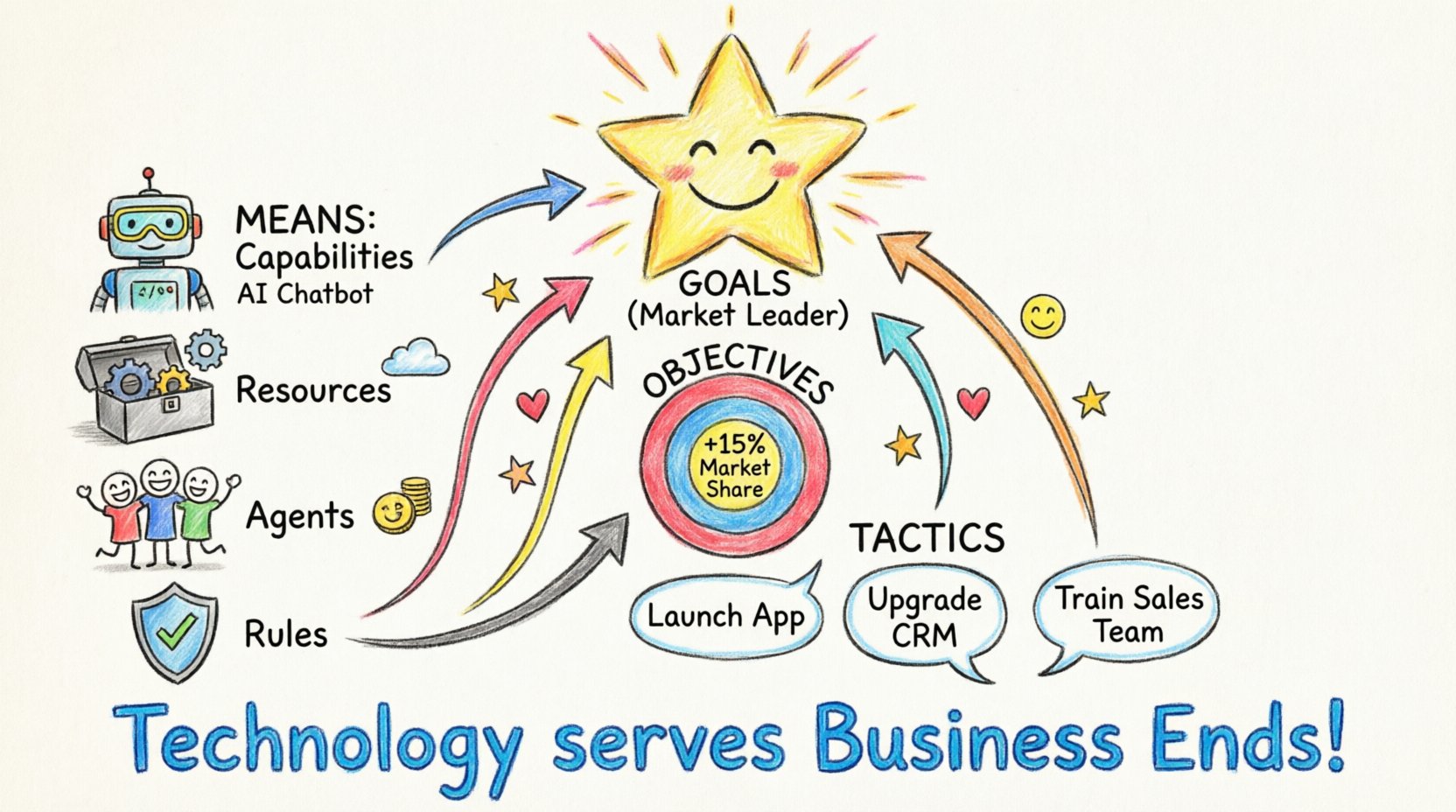
Understanding the Core Framework 🧠
The Business Motivation Model, standardized by the Object Management Group (OMG), is a conceptual framework designed to model business motivation. It does not dictate what a business should do, but rather how to structure the reasoning behind those actions. It separates the what from the how, creating a clear distinction between the desired outcomes and the mechanisms used to achieve them.
At its heart, the model relies on two fundamental categories:
- Ends: The results, outcomes, or states of the world that the organization desires to achieve.
- Means: The actions, resources, and capabilities employed to realize the Ends.
When technology initiatives are introduced, they are inherently Means. They are the tools used to achieve Ends. Without the BMM structure, technology teams often prioritize the Means (features, speed, uptime) without constantly validating them against the Ends (revenue growth, customer satisfaction, risk reduction). This leads to technical debt and strategic drift.
The Anatomy of Business Ends 🎯
To connect technology to value, one must first define the Ends clearly. The BMM breaks down Ends into a hierarchy of specificity, moving from broad aspirations to immediate targets.
- Goals: These are high-level, long-term aspirations. They are often qualitative and broad. For example, “Become the market leader in sustainable logistics.”
- Characteristics: Strategic, inspirational, long-term.
- Objectives: These are quantifiable targets that support a Goal. They provide the metrics for success. For example, “Increase market share by 15% within three years.”
- Characteristics: Measurable, time-bound, specific.
- Tactics: These are specific actions or plans designed to achieve Objectives. They are more operational than Objectives but still strategic. For example, “Launch a new mobile app to capture younger demographics.”
- Characteristics: Actionable, short-to-medium term.
Technology initiatives often get confused with Tactics. A new CRM system is a capability (a Means). Deploying it to improve sales conversion is a tactic. The ultimate Goal is profitability or market dominance. Understanding this hierarchy prevents teams from celebrating the deployment of a system while ignoring whether it actually moved the needle on the Goal.
The Anatomy of Business Means 🛠️
Once Ends are defined, the organization must identify the Means required to achieve them. In the context of IT, this is where technology initiatives reside, but the BMM definition of Means is broader than just software.
- Capabilities: The ability to perform an action. A technology capability might be “real-time data processing.”
- Characteristics: Functional, reusable, abstract.
- Resources: The tangible or intangible assets consumed to build or use capabilities. This includes servers, cloud credits, developer time, and budget.
- Characteristics: Consumable, finite, cost-bearing.
- Agents: The actors who utilize the resources to build capabilities. This includes development teams, architects, and business analysts.
- Characteristics: Human or organizational entities, responsible for execution.
- Rules: The constraints or regulations that govern the actions. Compliance standards, security policies, and architectural guardrails fall here.
- Characteristics: Mandatory, limiting, defining boundaries.
By categorizing technology initiatives as Means, leaders can ask the critical question: Which End does this Mean support? If a technology project cannot be traced back to a specific Goal, Objective, or Tactic, its strategic justification is weak.
Mapping Technology to Strategy: The Alignment Matrix 🌉
The core value of BMM lies in the relationships that link Ends and Means. These relationships define the flow of value through the organization. Understanding these links is essential for project prioritization and resource allocation.
Below is a structured breakdown of how these elements interact within a technology context.
| Element Type | Definition | Technology Context Example | Relationship to Ends |
|---|---|---|---|
| Goal | High-level aspiration | Improve Customer Experience | Ultimate destination |
| Objective | Measurable target | Reduce support ticket resolution time by 20% | Quantifiable milestone |
| Capability | Functional ability | AI-driven Chatbot System | Enabler of the Objective |
| Resource | Asset consumed | Cloud Computing Credits | Cost of the Capability |
| Agent | Actor performing action | DevOps Team | Executor of the Capability |
Notice the flow: The Agents use Resources to build Capabilities, which serve to achieve Objectives, which fulfill Goals. This creates a traceability chain. If the Cloud Computing Credits (Resource) are cut, the DevOps Team (Agent) cannot build the Chatbot (Capability), the resolution time (Objective) will not improve, and the Customer Experience (Goal) will suffer.
The Alignment Process: A Step-by-Step Approach 📋
Implementing this model requires a disciplined approach. It is not a one-time exercise but an ongoing practice of governance. The following steps outline how to operationalize the Business Motivation Model for technology initiatives.
1. Establish the Strategic Baseline
Before discussing technology, the business strategy must be articulated. Leadership must define the Goals and Objectives. These should not be vague statements but clear, measurable targets. Without this baseline, technology teams are guessing at the target. Engage stakeholders to ensure these Ends are understood across the organization.
2. Inventory Existing Capabilities
Conduct an audit of current technology capabilities. What systems exist? What functions do they perform? Map these capabilities to the existing Means. This reveals gaps where technology does not exist to support a specific Objective. It also highlights redundancies where multiple capabilities serve the same End.
3. Define New Initiatives as Means
When a new technology project is proposed, it must be classified strictly as a Means. It cannot be the Goal itself. For instance, “Migrate to the Cloud” is not a Goal; it is a Capability upgrade. The Goal might be “Reduce operational costs by 10%.” The Cloud migration is the Means to achieve that cost reduction.
4. Establish Relationships
Formalize the links between the new Initiative (Means) and the Business Target (End). Use influence or dependency relationships. Does the initiative positively influence the Objective? Does it depend on specific Resources being available? Documenting these links creates a dependency map that highlights risks.
5. Validate with Agents
Ensure the Agents (teams) understand their role in this chain. If a developer is building a feature, they should know which Objective it supports. This empowers teams to make better architectural decisions. If a feature does not contribute to the Objective, it may be scope creep.
Common Pitfalls and Mitigation Strategies ⚠️
Even with a robust model, organizations often stumble. Recognizing these patterns early allows for correction.
- Pitfall: Technology for Technology’s Sake
- Issue: Adopting a new framework because it is trendy, without a specific business Objective to support.
- Mitigation: Require a BMM linkage for every project charter. If the End is not defined, the project is not approved.
- Pitfall: Misaligned Objectives
- Issue: IT Objectives differ from Business Objectives. IT measures uptime; Business measures revenue.
- Mitigation: Translate IT metrics into business value. Uptime is valuable because it prevents revenue loss.
- Pitfall: Resource Constraints Ignored
- Issue: Planning capabilities without accounting for the Resources needed to sustain them.
- Mitigation: Include resource planning in the initial BMM mapping. Ensure budget and talent are linked to the Means.
- Pitfall: Static Modeling
- Issue: Creating the model once and never updating it as the market changes.
- Mitigation: Review the BMM annually or quarterly. Goals change, and Means must adapt accordingly.
Measuring Success and ROI 📈
How do you know the alignment is working? The Business Motivation Model provides the framework for measurement. Since every Initiative is linked to an Objective, success is measured by the achievement of that Objective.
- Direct Metrics: If the Objective is to reduce latency, measure latency. Do not measure code lines written.
- Indirect Metrics: If the Goal is customer satisfaction, measure Net Promoter Score (NPS) or churn rate, even if the Initiative was a backend refactor.
- Efficiency Metrics: Measure the cost of the Means relative to the value of the Ends. If the Resource cost exceeds the value generated by the Capability, the model indicates an inefficiency.
This approach shifts the conversation from “Did we finish the project?” to “Did we achieve the business end?”. It is a subtle but powerful shift in accountability.
Future-Proofing Your Strategic Architecture 🔮
Business environments are volatile. Market conditions shift, competitors emerge, and regulations change. The BMM is designed to be adaptable. Because it separates Ends from Means, organizations can swap Means without altering the Ends.
For example, if a specific technology vendor becomes obsolete, the Capability can be rebuilt using different Resources and Agents. The Goal remains the same. This flexibility is crucial for long-term resilience. It allows the organization to pivot quickly without losing strategic focus.
Furthermore, as Artificial Intelligence and automation become more prevalent, the definition of Capabilities will evolve. The BMM allows these new capabilities to be integrated seamlessly. The model does not care what the technology is; it cares what the technology does for the business ends.
Sustaining the Culture of Alignment 🤝
Tools and models are useless without cultural adoption. The Business Motivation Model requires a shift in mindset across the organization.
- Shared Vocabulary: Ensure everyone understands terms like Goal, Objective, and Capability. Ambiguity kills alignment.
- Transparent Documentation: Make the BMM maps visible. Developers should be able to see how their work impacts the top-level Goals.
- Continuous Feedback: Create channels for Agents to report when a Means is not achieving the intended End. This allows for rapid iteration.
- Leadership Buy-in: Executives must champion the model. If leadership ignores the alignment, the teams will too.
By embedding these practices, the organization moves from a project-based delivery model to a value-based operating model. Technology becomes a dynamic instrument of business strategy rather than a static utility.
Summary of Key Takeaways 📝
The Business Motivation Model offers a rigorous method for connecting technology initiatives to business ends. It forces clarity on what is desired (Ends) and how it will be achieved (Means). By rigorously applying this framework, organizations can eliminate wasted effort, ensure resource efficiency, and maintain strategic focus amidst change.
Key principles to remember:
- Ends drive Means: Technology must always serve a defined business outcome.
- Traceability is essential: Every project must link back to a Goal or Objective.
- Adaptability is key: Means can change, but Ends provide the stable anchor.
- Measurement matters: Success is defined by the achievement of business value, not just technical completion.
Adopting this model is a journey toward operational excellence. It requires discipline and commitment, but the reward is a technology function that is deeply integrated with the core mission of the enterprise. In a world where digital transformation is often touted as the solution, the Business Motivation Model provides the foundation for ensuring that transformation actually delivers results.