


Organizations frequently face a disconnect between their strategic aspirations and their technical execution. Business leaders define a vision for growth, efficiency, and market dominance, yet IT departments often deliver systems that do not directly support those high-level objectives. This misalignment results in wasted resources, missed opportunities, and technologies that become obsolete before they can deliver value. To bridge this gap, a structured approach is required to translate business intent into technical capability. The Business Motivation Model (BMM) provides this framework.
This guide explores how to leverage the BMM to ensure IT roadmaps are not just technical checklists, but strategic enablers. By mapping corporate goals to IT initiatives, organizations can ensure every line of code, every infrastructure upgrade, and every software deployment contributes to the broader mission. We will examine the core components of the model, the process of integration, and the metrics required to sustain alignment over time.
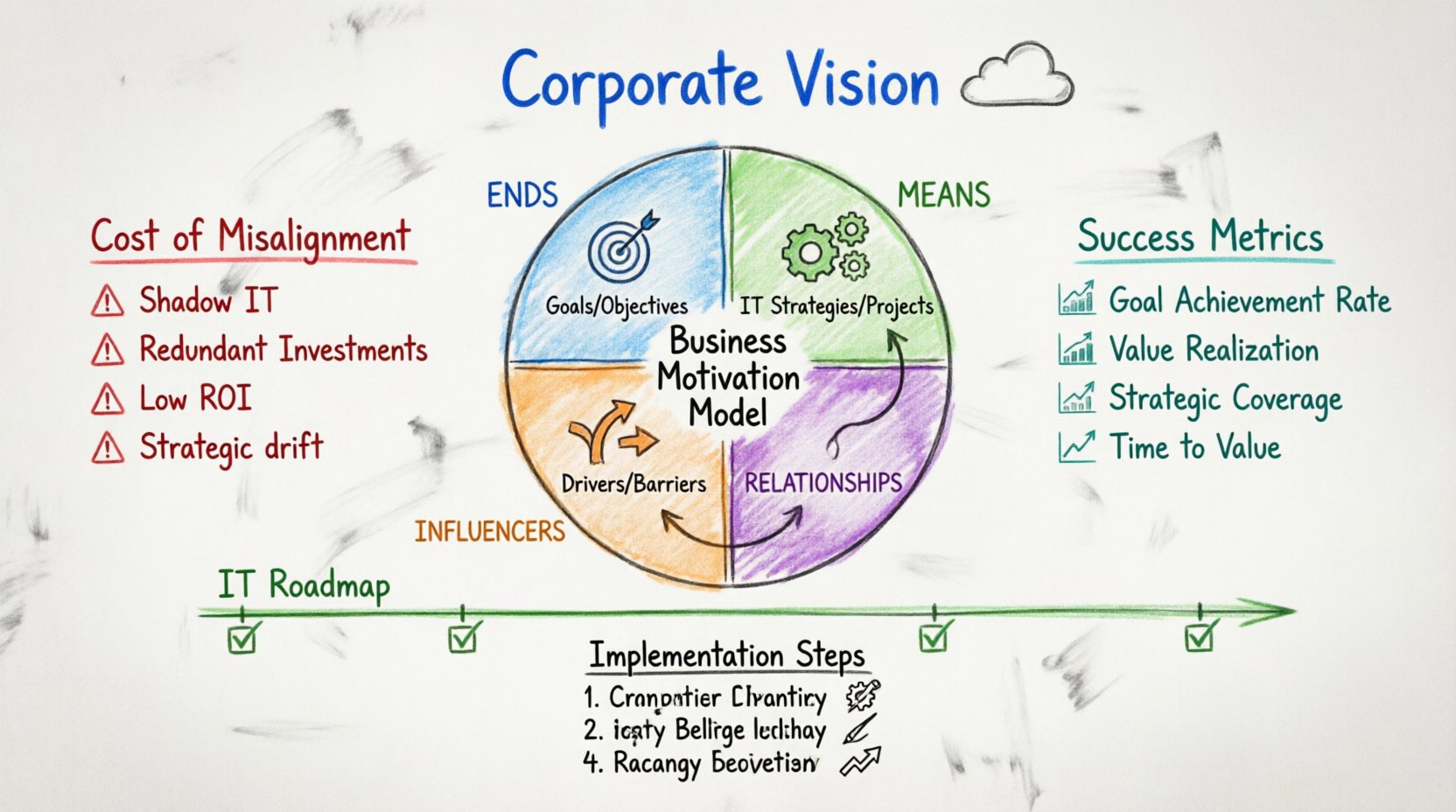
🧩 Understanding the Business Motivation Model
The Business Motivation Model is a standard framework designed to describe the motivation behind business decisions. It separates the “why” from the “how,” allowing planners to distinguish between the desired outcomes and the actions taken to achieve them. In the context of IT strategy, BMM acts as a translator between business stakeholders and technical architects.
At its core, the model relies on four primary categories of elements:
- Ends: These represent the goals or objectives the organization wishes to achieve. They are the “what” the business wants to happen. Ends can be further divided into Goals (desired states) and Objectives (measurable criteria for success).
- Means: These are the strategies, plans, and capabilities used to satisfy the Ends. In an IT context, Means often include IT projects, technical architectures, and operational processes.
- Influencers: These are the factors that drive or hinder the satisfaction of Ends. Influencers can be positive (drivers) or negative (barriers). They include regulations, market trends, budget constraints, and technical debt.
- Relationships: The links connecting these elements. For instance, a Strategy influences a Plan, which satisfies a Goal.
When applied to IT, this structure prevents the common error of building technology for technology’s sake. Instead, every technical initiative must trace back to a specific Business Goal. If an IT project cannot be linked to a Means that satisfies an End, it should be questioned.
📉 The Cost of Misalignment
Without a structured model like BMM, IT roadmaps often become reactive. Teams prioritize urgent requests over strategic ones. This leads to several tangible issues:
- Shadow IT: Departments bypass IT to solve problems quickly, creating security risks and data silos.
- Redundant Investments: Multiple teams purchase similar tools without knowing what others have already deployed.
- Low ROI: Significant budget is spent on features that do not improve customer experience or operational efficiency.
- Strategic Drift: Over time, the technology landscape changes, but the roadmap does not pivot to match the business direction.
Using BMM forces accountability. It requires stakeholders to define the specific value a technical capability brings to the organization. This transparency helps prioritize the backlog based on business impact rather than technical complexity.
🛠️ Implementing BMM for IT Alignment
Integrating the Business Motivation Model into IT planning requires a shift in how roadmaps are constructed. It is not about adopting new software, but about adopting a new way of thinking about requirements and deliverables. The following steps outline the implementation process.
1. Define Corporate Ends Clearly
The foundation of alignment is a clear statement of purpose. Business leaders must articulate their Ends. These should not be vague statements like “improve customer satisfaction.” They must be specific.
- Vague: “Increase sales.”
- Specific: “Increase online sales by 20% within 12 months through improved checkout speed.”
IT teams need these specific Ends to design appropriate technical solutions. If the goal is speed, the roadmap prioritizes performance optimization. If the goal is market expansion, the roadmap prioritizes localization and scalability.
2. Identify Business Needs and Influences
Once Ends are defined, identify what is needed to achieve them. This involves cataloging Influencers. These are the constraints and enablers.
- External Influencers: Competitor actions, regulatory changes, economic shifts.
- Internal Influencers: Budget limits, skill availability, legacy system constraints.
Documenting these influences early prevents the roadmap from becoming unrealistic. For example, if a new regulation requires data residency, this is a hard constraint that must be reflected in the infrastructure plan.
3. Map IT Capabilities as Means
IT initiatives are the Means. They are the mechanisms used to satisfy the business Needs. This mapping is the critical step. Every project in the roadmap must be tagged with the Business Goal it supports.
Consider a scenario where the business wants to reduce operational costs (End). The business need is to automate manual reporting. The IT capability (Means) is a new BI tool. The relationship is that the BI tool satisfies the reporting need, which satisfies the cost reduction goal.
4. Validate with Stakeholders
Before finalizing the roadmap, validate the model with business stakeholders. Do they agree that the proposed IT initiatives will actually achieve the stated Ends? This step often reveals gaps where technology cannot solve a business problem, or where the business problem is not understood by IT.
📊 Mapping BMM Elements to IT Artifacts
To visualize the alignment, it helps to map standard IT planning artifacts to BMM elements. The table below illustrates how traditional planning items translate into the motivation model.
| IT Artifact | BMM Element | Purpose in Alignment |
|---|---|---|
| Strategic Goals | Ends (Goals) | Defines the desired future state. |
| Business Requirements | Needs / Influencers | Specifies constraints and functional needs. |
| IT Initiatives / Projects | Means (Strategies / Plans) | Describes the actions taken to achieve goals. |
| System Capabilities | Means (Capabilities) | Describes the functional capacity of the solution. |
| Success Metrics (KPIs) | Ends (Objectives) | Measures the achievement of the goal. |
| Risk Register | Influencers (Barriers) | Identifies factors that could hinder success. |
This mapping ensures that when a project is added to the roadmap, its business justification is explicit. It moves the conversation from “We need a database” to “We need a database to support the Goal of Real-time Inventory Tracking.”
🔄 Managing Dynamic Influences
Business environments are not static. A roadmap built today might be obsolete in six months due to a change in Influencers. The BMM framework supports agility because it separates the End from the Means. If a Goal remains valid but the external Influencers change, the Means can be adjusted without abandoning the End.
For example, if a corporate Goal is “Enter the Asian Market,” but a regulatory Influencer changes to require local data hosting, the IT Strategy (Means) changes from “Cloud Global” to “Cloud Local.” The Goal remains the same, but the execution adapts. This flexibility is crucial for maintaining alignment in volatile markets.
To manage this effectively:
- Regular Reviews: Schedule quarterly reviews of the Influencer list. Are there new regulations? New competitors? New internal budget cuts?
- Feedback Loops: Ensure IT feedback reaches business strategy. If technical debt is slowing down delivery, it becomes a new Influencer that must be addressed in the plan.
- Scenario Planning: Use the model to model different futures. “If Influencer X happens, how does our Means change?”
📈 Measuring Success and Impact
How do you know the alignment is working? You need metrics that connect technical output to business outcome. Standard IT metrics like uptime or ticket resolution are important, but they are not enough. They measure performance, not alignment.
Adopt outcome-based metrics:
- Goal Achievement Rate: Percentage of IT initiatives that directly contributed to a defined Business Goal.
- Value Realization: Actual financial or operational benefit compared to the projected benefit at the start of the project.
- Strategic Coverage: Percentage of the IT budget allocated to initiatives that map to top-tier Corporate Goals.
- Time to Value: How quickly does an IT initiative deliver the intended business outcome?
Tracking these metrics helps identify misalignment early. If a significant portion of the budget is spent on initiatives that do not link to a Goal, the roadmap needs correction. This data-driven approach removes guesswork from strategic planning.
🚧 Common Pitfalls and Challenges
Implementing BMM is not without challenges. Organizations often stumble when trying to apply the model. Awareness of these pitfalls can help avoid them.
- Over-Engineering the Model: The model should be simple enough to use. Creating complex diagrams for every minor goal creates bureaucracy. Keep the hierarchy shallow for operational goals.
- Ignoring the “Why”: Focusing too much on the Means (projects) and neglecting the Ends (goals). This brings us back to the original problem of building things that don’t matter.
- Lack of Business Ownership: If IT owns the BMM map alone, it becomes a technical exercise. Business stakeholders must own the Ends and Influencers. IT owns the Means.
- Static Documentation: Treating the model as a one-time document. It must be a living artifact that evolves with the business.
🤝 Fostering Collaboration Between Teams
Beyond the mechanics of the model, alignment is a cultural shift. It requires closer collaboration between business leaders and technology teams. Workshops should be held to map Ends to Means together. This shared ownership reduces the “us vs. them” mentality.
When business stakeholders understand the constraints of the Means (technical reality), they provide more realistic Goals. When IT understands the urgency of the Ends (business reality), they prioritize better. This mutual understanding is the true value of the Business Motivation Model.
🔍 Final Considerations for Strategic Planning
Aligning IT roadmaps with corporate vision is a continuous process, not a destination. The Business Motivation Model offers the structure needed to maintain this alignment as the organization grows and changes. By clearly defining Ends, identifying Influencers, and treating IT initiatives as Means, organizations can ensure their technology investments drive real business value.
The shift from technical delivery to strategic enablement is significant. It requires discipline, clear communication, and a willingness to adapt. However, the result is a cohesive organization where technology and business move in the same direction. This synergy is the foundation of sustainable growth and competitive advantage in the modern digital landscape.
Start by auditing your current roadmap. Identify which initiatives link to corporate goals and which do not. Use the BMM framework to bridge the gaps. Over time, this practice will embed strategic thinking into the daily work of your IT department.